
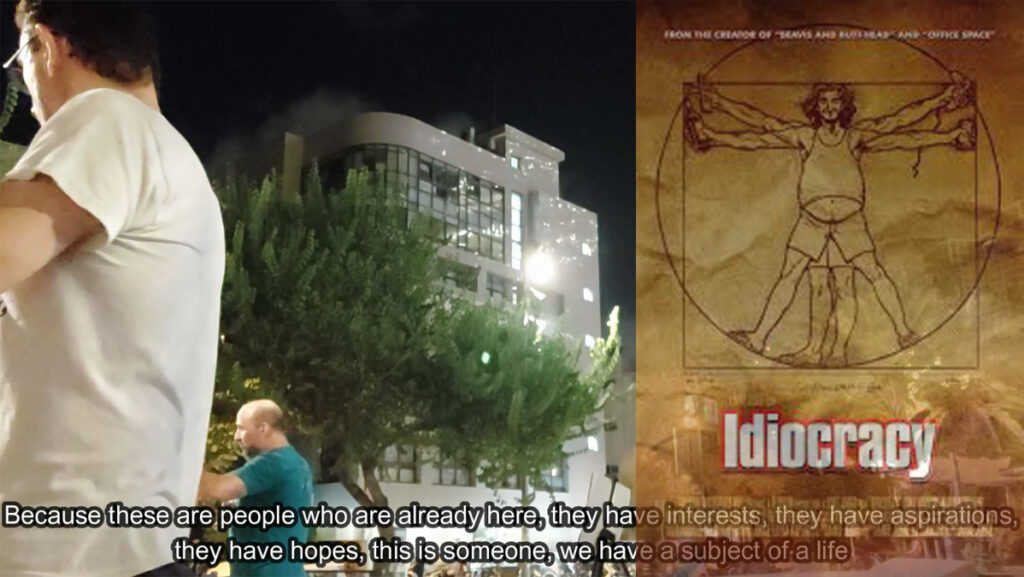
There was a special screening of the film Idiocracy recently. Although the film does not necessarily carry an antinatalist message (and some would even say the opposite), I thought it was an excellent opportunity to talk about antinatalism.
At a certain point, a three-way conversation was created, and dealt with adoption as a solution for people who really want to be parents but don’t want to create a new person, a distinction and clarification that antinatalism does not stem from a fear for the happiness of the parents but of their children if they have them, and whether antinatalism prioritize non-existence over existence.
A conversation that started with that there are all kinds of ways to start a family, moved on to the risk argument, clear cases of miserable lives, Buddhism, and the double trap inherent in the claim that ‘it’s always possible to commit suicide’
While I very much agree with the consent argument, somehow I tend to bring it up and highlight it less than other antinatalist arguments. In this conversation, held during an antinatalist outreach event at a special screening of the film Idiocracy, it was shortly discussed. And led to extinction (like in so many other discussion about antinatalism…). But what about love though, was also brought up? And in the end, the right to end (our existence).
At some point someone walked by and just throw that we are insane and that this is crazy. I told him not to be a coward and walk away but to come and confront us. He came. It was… interesting…
Usually, group conversations at antinatalist outreach events are more heated and argumentative. But at the outreach event at the screening of Idiocracy, the most pleasant, open, and curious conversation was a group conversation. It was like a group interview, on the street, with a lot of curiosity and openness. Beyond the arguments that I try to raise in every conversation, such as the fact that every new person is likely to be a victim and will certainly be a victimizer because every person causes a lot of suffering to a lot of others, many topics came up. Along with adoption and extinction which came up often, we also talked about attitudes toward parents, socialism and communism, pessimism, realism, the impact on personal lives, fertility treatment, and reproduction among nonhuman animals. This is more or less what street conversations about new and unfamiliar topics should look like.
In one of the most interesting conversations, I raised the argument that we have a moral obligation to prevent suffering while we have no moral obligation to create happiness. This was part of an attempt to explain and base the famous asymmetry argument.