
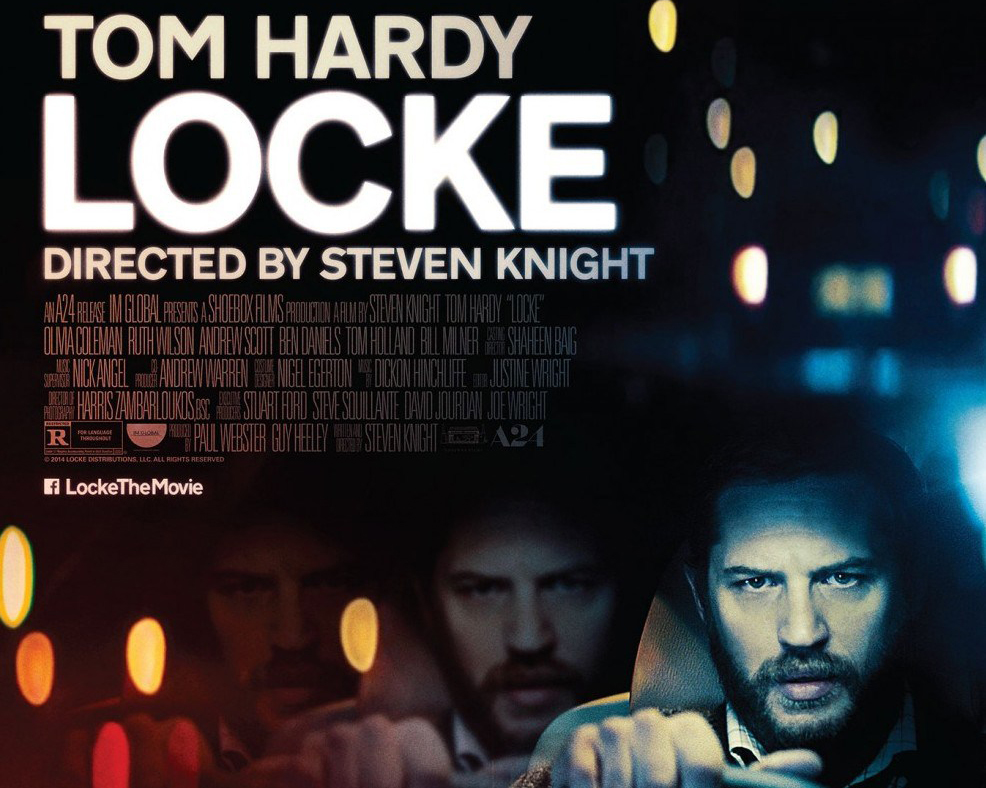
The film Locke follows, in this case literally, the journey of a man named Ivan Locke from his job in Birmingham to a hospital in London. I say literally, because the movie begins with Locke getting into his car after work, and the entire movie takes place in the car as he drives to the hospital. And the reason I find it relevant and interesting to review this movie from an antinatalist perspective is that this man drives to the hospital because a woman he slept with seven months earlier told him she was going to give birth prematurely.
Important reminder: Like other antinatalist reviews of movies and TV shows, this review is full of spoilers, so anyone who hasn’t seen the movie and is planning to do so, please watch the movie first and then read this text.
Basic Plot
The film opens with the only shot taken from outside the car (apart from a few brief shots of the car driving from the outside). It is a huge construction site. The site manager, Ivan Locke, exits it and approaches his car. Before getting in, Locke takes off his very dusty shoes, in what seems like a meaningless routine, but is actually a symbolic gesture that will be explained later. He starts driving and very quickly stops at a red light. He signals left, but hesitates when the light turns green. A truck driver behind him honks his horn, effectively pushing him to change his decision and drive right instead. The music changes at that exact moment, indicating that this is not a trivial decision but that Locke is taking the right turn.
Earlier that day, Locke received a message from Bethan, his colleague from a previous job, with whom he had sex once seven months earlier, which ended in pregnancy. Bethan called to tell Locke that she was going into premature labor.
Locke hesitated before deciding to go to the hospital because that evening happened to be the day before the largest concrete pour ever carried out in Europe (apart from nuclear and military projects), and he was to supervise it. This, and because his wife and two sons, who were eagerly waiting for him at home to watch a football match together, knew nothing of the pregnancy at this point.
The drive from the construction site to the hospital took about an hour and a half. During this time, Locke had to solve several problems, all via the car’s speakerphone. He started with Bethan, whom he informed (via voicemail) that he was on his way, then with Gareth, his boss (who didn’t answer so he left a voicemail for him too), and then he rang home. His son Eddie answered and Locke told him, to his disappointment, that something had come up and he wasn’t coming home to watch the match. His wife wasn’t home because she had gone to buy him his favorite beer for the match.
The next call is to Donal, one of Locke’s employees, who is shocked that Locke has thrown the responsibility of 355 tons of concrete to be pumped by 218 trucks on him out of nowhere. Locke tells Donal that he has no choice and that he can’t be there. Donal is sure that this is a joke and continues to tell Locke that he can’t do this job alone. Locke convinces him that he will be there the whole time on the phone and that everything will be fine.
And with that same confidence and sense of control, Locke tries to deal with everything else related to that complicated night.
Cracks of Life
Bethan calls Locke back from the hospital. She tells him that she is in pain, that she is cold, and that she is alone in the maternity ward. Locke is very unempathetic towards her. He tells her in a cold tone to tell the nurses to close the windows and get some painkillers, and that he is on his way. Bethan asks him if he loves her and he answers in the same cold and alienated tone: “That’s a question you’re asking probably because of the pain or something. How could I love you? I…” Bethan hangs up. Locke is very concrete.
Locke’s profession was not chosen at random. Concrete plays a central role in this film, which is in many ways about control. Locke is portrayed as a very strict, well-organized, reliable, and responsible person. Locke corrects Donal that there will be 218 trucks, not 220, and he corrects his boss during their argument about Locke not being present at the concrete pour, that he has been working with him for 9 years, not 10, meaning he is a very precise person, even when precision doesn’t work in his favor. Locke asks Donal to personally check everything that night because that’s how he always does things. Everything has to be precise and under control or things will fall apart, as he explains to Donal after asking him what would happen if one truck had C5 concrete mix instead of C6:
Locke: “It says C6. And you know why? Because, eventually, when my building is complete, it will be 55 floors high. It will weigh 2,223,000 metric tons. Okay? My building will alter the water table and squeeze granite. It will be visible from 20 miles away. At sunset, it will cast a shadow probably a mile long. Now, if the concrete at the base of my building is not right, if it slips half an inch, cracks appear. Right? If cracks appear, then they will grow and grow, won’t they? And the whole thing will collapse. You make one mistake, Donal, one little fucking mistake, and the whole world comes crashing down around you.”
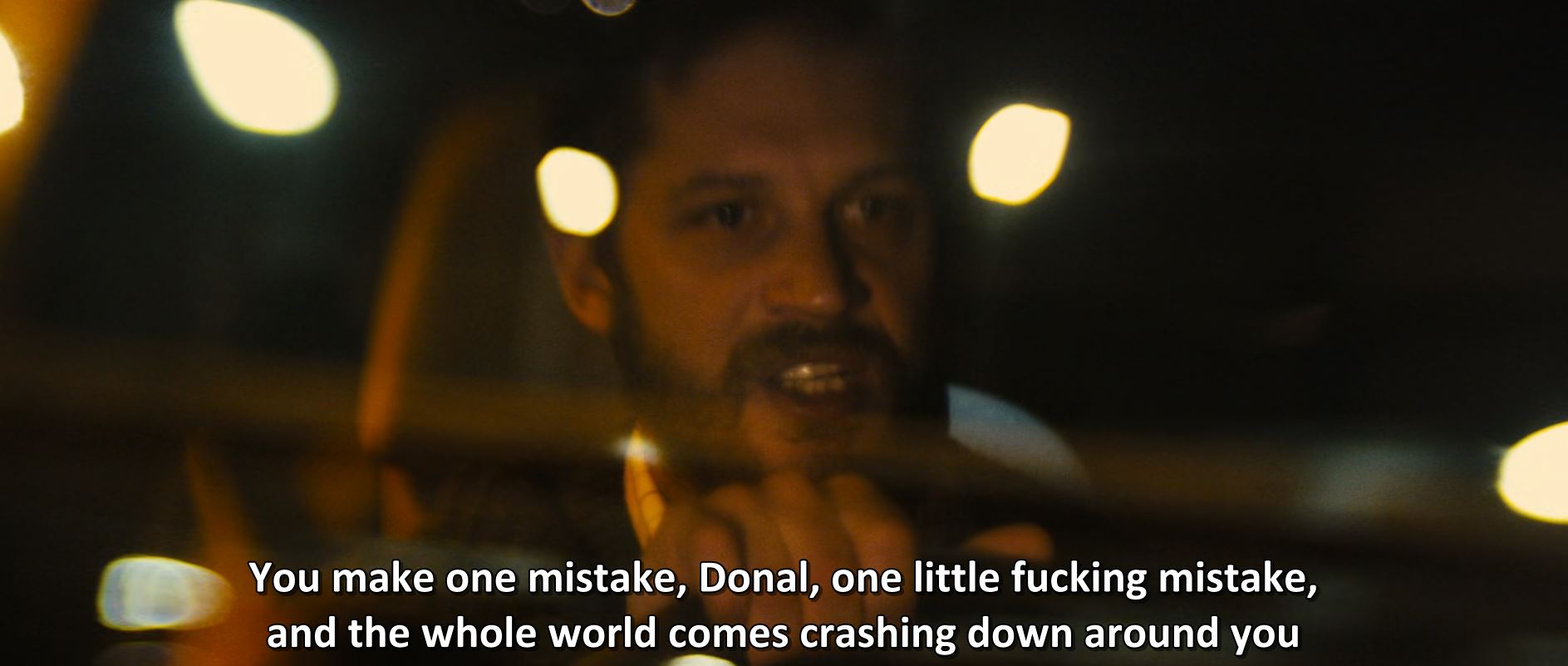
And like concrete, in life, one crack is enough for the world around you to collapse.
Locke’s wife, Katrina, calls him back and he tells her why he’s not coming home:
Locke: “Last year, this job…You know, the job in Croydon. Do you remember? I was up and down there for three months. Remember? I stayed in the guesthouse, the one that had…It had bad damp, I said.
They gave me an assistant. She worked with me on the block construction. She was a secretary, quite old. We… We worked together. She’s quite old and she lives on her own. She’s 43 or something. She’s…”
Katrina: “Why are you telling me about some woman?”
Locke: “This is the only time I ever did this, Katrina. The only time.
Look, after the block was settled in, there were some drinks to celebrate. Now, the block going in is a big thing because it’s the base of a whole building. And she came back to the guesthouse.
She isn’t what you would call an oil painting, but it was wet and cold, and she talked about being lonely and I talked about being happy. But I’m lonely sometimes, you know, when I was away, and…
And there was this wine and…
This was the only time I did this in all our 15 years.
And now tonight she’s giving birth. Tonight she’s giving birth and it’s mine.”
Katrina hangs up.
Katrina calls back and tells Locke: “That didn’t happen. I’m not believing it.”
Locke insists on being in control and concrete: “Katrina, I want to move to a practical next step.”
But Katrina isn’t: “I’m here in the dark in our bedroom and…Oh, God, nothing looks the same.
Ivan? I can’t… I can’t speak very well. I…”
Locke: “I have felt scraped-out for months. She phoned and said that she was having a baby and keeping it because it was her last chance to be happy. And then tonight she phoned and said the waters broke and it’s two months early. I was… I was going to tell you before, but the waters broke early, so I have to do this now in the car. Every night I was going to tell you.”
Katrina: “God, I can’t… I can’t really breathe.”
Locke: “Katrina, listen. You know what happened with my dad, right?
And how that bastard wasn’t around for me. Didn’t even give me a fucking name.”
Katrina: “No, no, you’re confused. Ivan, it’s you that’s the bastard. It’s the baby that’s the bastard. For God’s sake, Ivan, at least get the word right.”
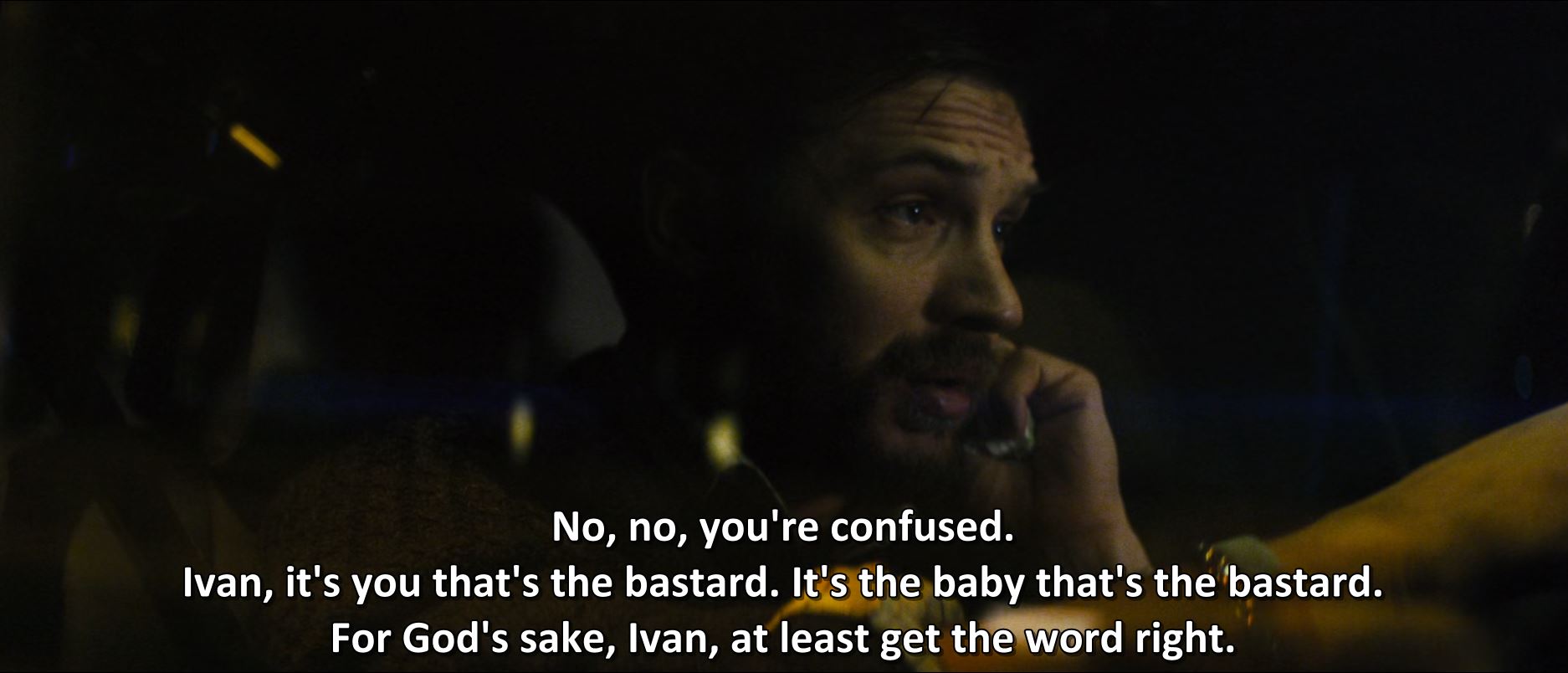
And Katrina is right to remind Ivan that it should be about the child, not the father, and certainly not about his father’s father. But it is. This is the motivation behind Locke’s willingness to ruin his life, hurt his family, his wife, and his two sons, place such an enormous responsibility on his employee, stress and disappoint his boss, get himself fired from his beloved job, and jeopardize the huge building he seems so proud of, all to show his late father that he is a better person than he was. He is not doing this for the baby, who would not remember being born anyway. And he is not doing this for Bethan, who he has been very cold to and seems not to have even spoken to her since she told him she was pregnant. When Bethan tells him: “It’s funny it was someone like you, someone so opposite to me. All the things I love mean absolutely zero to you” he distantly replies: “The important thing is to get the baby out.”
Another example is that after receiving a call from the senior obstetrician at the Hospital explaining to Locke that the baby’s umbilical cord is wrapped around the baby’s neck and therefore they need to carry out a cesarean but Bethan insists to wait for Locke, he convinces her to have the procedure, saying: “Now, a baby is something that cannot be stopped. You have to take all the practical steps to prepare.”
Bethan: “You want me to let them cut me open.”
Locke: “Yes. I mean, it is the best thing.”
Bethan: “Okay. I’ll do it because I love you.”
Locke: “Okay, then.”
Bethan: “Can you not say it back, even once?”
Locke: “No, I can’t. Look… I can’t. But I can be there as fast as the traffic will allow.”
I’m not saying that Locke should have told Bethan he loved her back, that could be a harmful deception, but if he had thought about her best interests, he would have been much more empathetic, sensitive and understanding, instead of being very cold and concrete. But he is on a mission to prove a point to his dead father, not to support a woman in labor who he impregnated and barely cares about. He is doing this to prove a point to himself. That he is not like his father, that he is better. And his father issues are so strong that even an intelligent, organized and in control person like him, does not think logically, for example he could have told his family that he had to be on site that night, go to the hospital, then drive back to the site before 5:25 am to supervise the concrete pouring and then come home and tell the family the truth, in person, not over a speakerphone.
We witness how significant Locke’s father issues are when, between his conversations on the car speakerphone with real people, he loudly confronts his dead father, supposedly looking at him through the car mirror, and says, for example:
“What the fuck are you looking at? You’re laughing, aren’t you? Laughing at my predicament.
It’s a familiar predicament to a man like you, isn’t it, Dad, eh?
You think, “There he is, look. Like father, like son. There’s the man I made.” What is it they say? “The apple doesn’t fall far from the tree.” Well, that’s where you’re wrong.
Listen to me, you fucking piece of worthless shit. I want you to watch. Do you know, in fact, I would like to take a fucking shovel and dig you up out of the fucking ground and make you watch me tonight. I would pull open your eyes and kick the mud and worms and shit out of your fucking ears just for the duration of this journey. Because it’s me driving. Me, not you.
And, unlike you, I will drive straight to the place where I should be, and I will be there to take care of my… To take care of my fuck-up.”
Aside from the true motive behind Locke’s journey, how does being present on his son’s birthday take care of his fuck-ups?
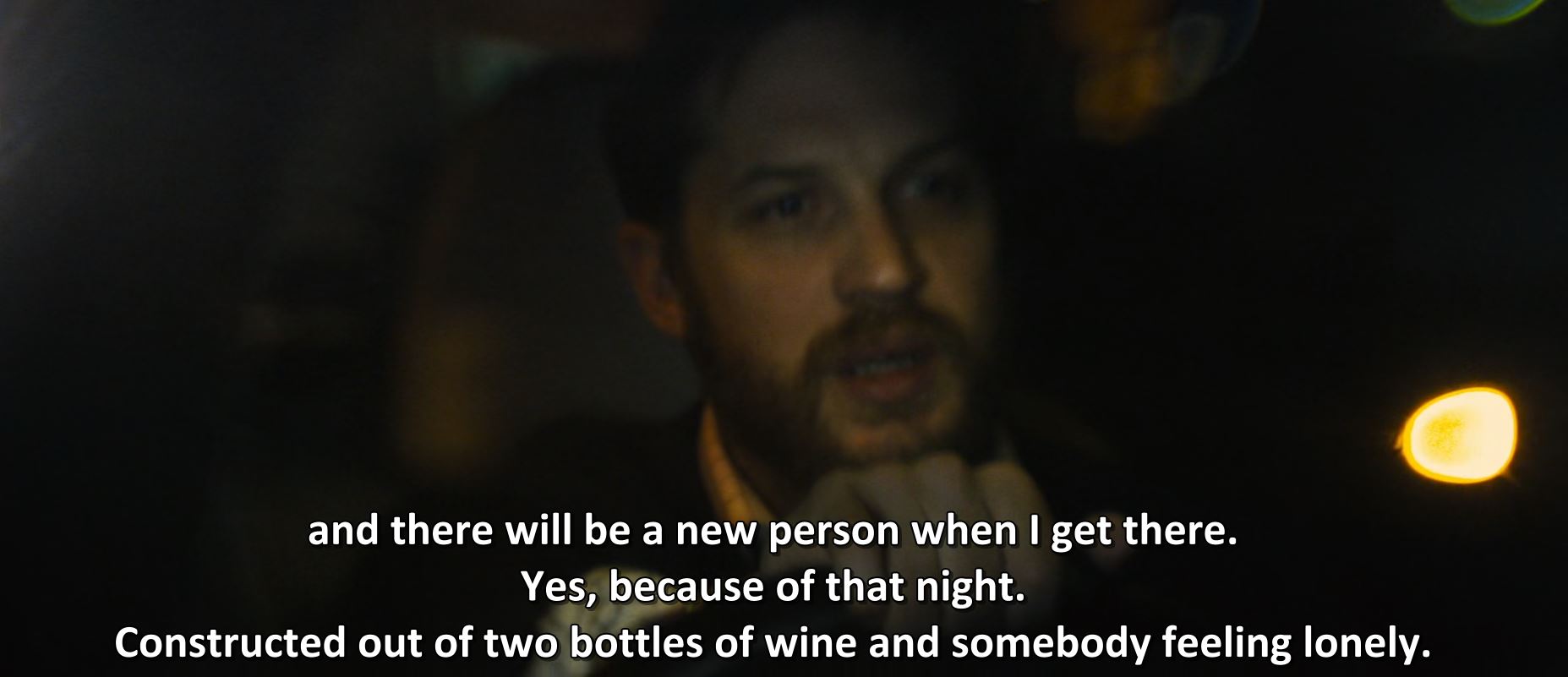
This boy will probably one day discover the circumstances of his creation, as stated in his father’s words: “Constructed out of two bottles of wine and somebody feeling lonely.” It’s hardly likely that after discovering the circumstances of its own creation this child would be comforted that at least his father was there on his birthday.
We don’t know how honest Locke is going to be with his child but if he would tell his child what he said to his father in one of their imaginary conversations, which is:
“You see? Life. Yes, life sentence.
So what? I will do what needs to be done, even if they hate me or love me.
You have to be solid so that it makes no difference what they think.
You know, if I were to bury you tonight, again, before I threw dirt on your face, I would say, “Look. Look and fucking learn.”
I drove in this direction and there will be a new person when I get there.
Yes, because of that night. Constructed out of two bottles of wine and somebody feeling lonely.”
It is hard to expect this child to be happy.
No one wants to feel like they are their father’s life sentence and their mother’s supposed last chance at happiness. No one wants to feel like they are the product of two bottles of wine and someone who felt lonely. And no one wants to feel like they are the cause of their family’s destruction. Not that they are. Obviously, it is not the child’s fault but the fault of their parents, but it is still likely that this child will feel this way, at least partially anyway. We don’t know if Locke will resent this child for the loss of his family and career, but that is also likely to happen.
Locke did make his decision to take care of his fuck-up, which is his fucking father. He’s not there for the child. If he cared about the child, he would have convinced his mother to have an abortion. Also for her sake, since she’s about to become a mother at 43 (probably the reason, or at least one of them, for the premature birth and maybe even for the complications that come with it), she’s a very lonely person, meaning she’s not expected to have much help raising the child, and she’s described by Locke as “sad and lonely, and hardly connected to life at all,” which is a terrible reason to become a parent, and a terrible starting point to become a parent. Therefore, neither she, nor her child, nor Locke himself are likely to be happy as a result of the mistake they made, which only grew bigger, adding another great sacrifice, after not taking care of it when they really could have.
On the surface, it’s her decision, but it’s a decision that Locke blesses, not curses. Before the surgery, he leaves her a voicemail saying, “Good luck, Bethan. This baby is a good thing. And you deserve to be happy.” Good thing, to whom? Bethan may indeed deserve to be happy, but why is creating someone the only option for her to be happy? And of course, what about the child’s happiness?
The starting point of this child and the circumstances that created him are unfortunate.
And as in construction, so in life, if the concrete at the base is not right, cracks appear. And if cracks appear, then they will grow and grow, and the whole thing will collapse.
For some reason, Locke ignores this. And generally, for someone who is supposedly so focused on doing the right thing, he seems to be very focused on doing the wrong things, like not telling his wife for a long time, insisting on telling her over the phone instead of waiting until the next day, putting such a heavy burden on one of his employees, stressing out his boss and his boss’s bosses, getting himself fired even though he now has two families to support, and we don’t know how this concrete pour will end, but there might be problems with that too. And all to prove a point to his now-dead father.
Locke firmly believes that, like bricks and mortar, no matter what the situation, it can be done well. Here it is in his own words, addressed to his dead father:
“You think this is all fate, don’t you, Dad? Your dirty fucking fingerprints all over me.
You thought it was bound to happen because of the little seeds that you planted.
Okay, well, let me educate you.
Even no matter what the situation is, you can make it good, like with plaster and brick.
You never knew that because you never lifted a finger, you fucking lazy cunt.
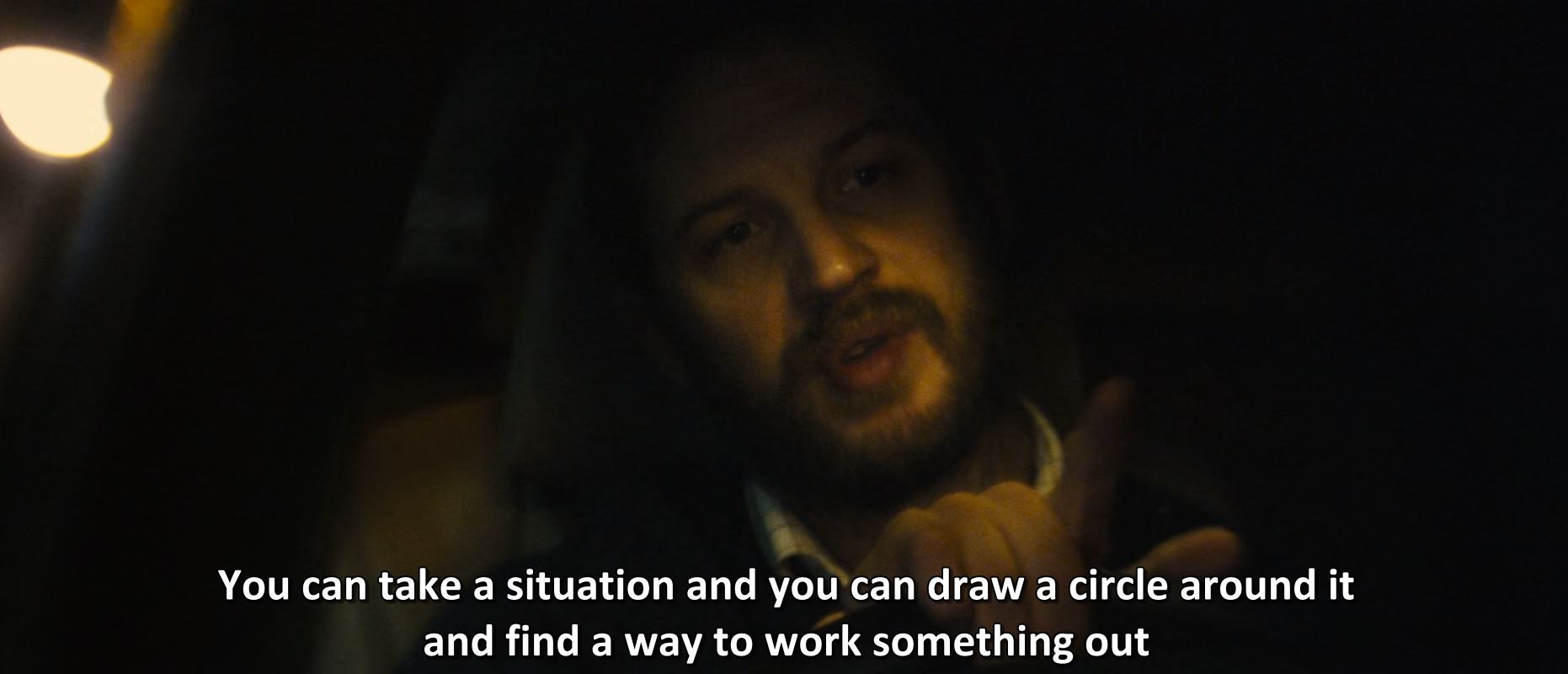
But you know what? You can take a situation and you can draw a circle around it and find a way to work something out.”
But that’s not how life works. Even in this film, that’s not how life really works. For example, Locke tries this approach in vain with his wife in another conversation they have. After Katrina discovers that Locke called to ask his son for the phone number of someone who works for the council’s officer so that he can approve a road closure for concrete pouring the next day, from a notebook in his coat at home, she calls Locke and says:
“Ivan, I just found Sean looking through your pockets. He said you asked him for a phone number.”
Locke: “Yes.”
Katrina: “Now, at this moment, you need a phone number?”
Locke: “I know how it looks, but I need to… I need to confirm a stop and go.
Tomorrow there’s a pour. It’s a big… It is historical. It is the biggest pour in Europe.”
Katrina: “Can you hear yourself, Ivan? I’m falling apart at home and you’re closing roads?”
Locke: “It’s not a closure, it’s a stop and go.”
Katrina: “The woman is giving birth and you’re closing roads.
Since you’ve told me about this woman, you have been getting further and further away from who I know.
No, actually, it might be that I do know.
In the… In the kitchen, your footprints, they go hard and I have to chip them away.
You leave concrete behind you everywhere.”
Locke: “Katrina, I love you. Okay? I made one mistake.
I don’t feel anything for this woman, and I’m trying to do the right thing tonight, because she is on her own and the baby is my fault.
And I know how it feels to be coming out into the world like this.
There is someone being brought into the world and it’s my fault.
So I have to fix it, somehow.”
Katrina: “Oh, my God.”
Locke: “I would really like it if you would say that you will wait and I can come back and we can talk…We can talk about it and that we can fix something up.
I really want to know that tomorrow I can drive home and talk to the boys and be at home as normal, and we can go out or something and have a drink and talk about it.
I want to know that I am not driving in one direction…
I want to know that I will be driving back when the sun comes up.”
But Katrina is adamant that some things cannot be fixed:
“Ivan?”
Locke: “Yes.”
Katrina: “I’ve decided.”
Locke: “Kat, you know what? We can work this out. I know we can.”
Katrina: “No, no, no. I’ve spoken to my sister and my half-sister. And the difference between once and never is everything. So, that’s it. And it never is once anyway.”
Locke: “Katrina, listen…”
Katrina: “I don’t want you to come back, Ivan.
This is not your home anymore and I want you to stay away.”
Locke: “Katrina, please, listen.”
Katrina: “We will make arrangements for seeing the boys.
But, look, I… I don’t want you coming here.
You were always more in love with your buildings anyway. Why don’t you go and live in one of them?
I mean, right at the top where you like to look out and feel so pleased with yourself.
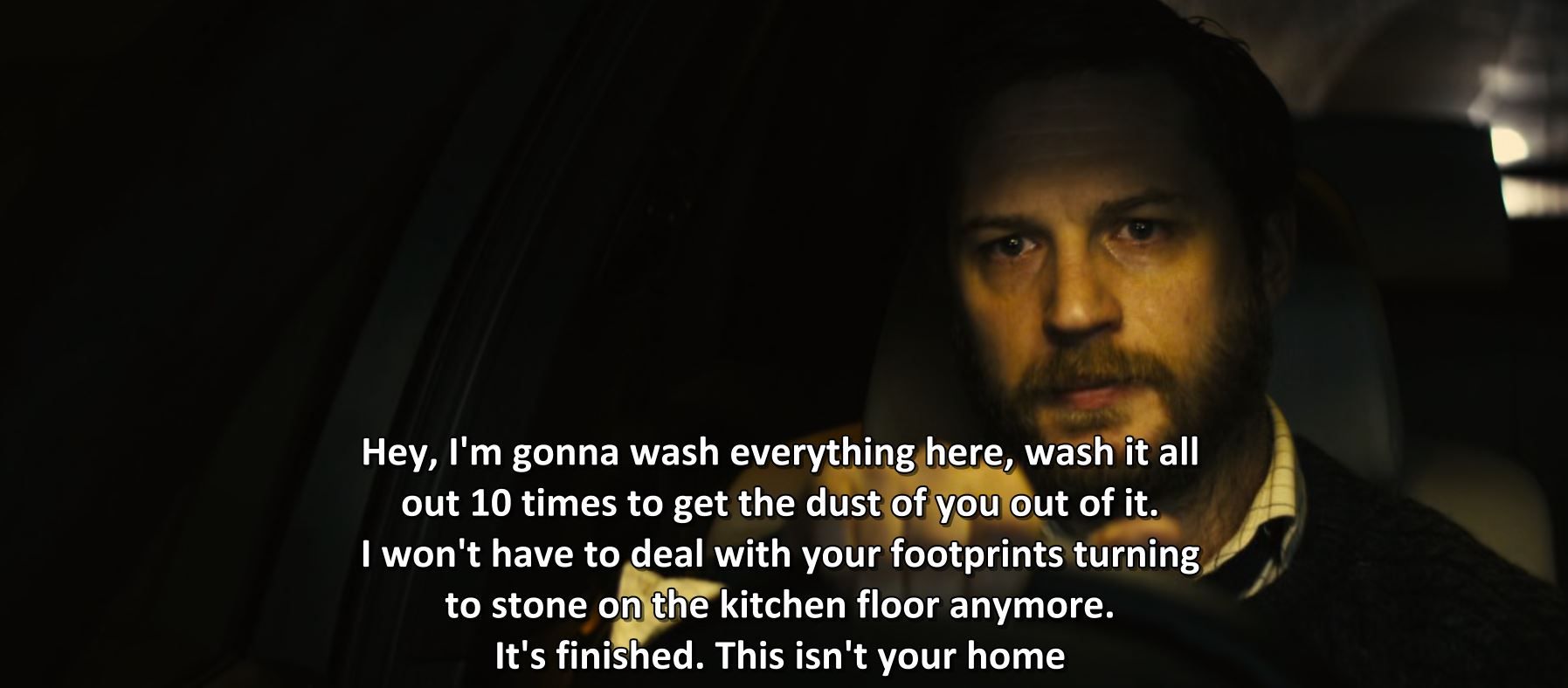
Hey, I’m gonna wash everything here, wash it all out 10 times to get the dust of you out of it.
I won’t have to deal with your footprints turning to stone on the kitchen floor anymore.
It’s finished. This isn’t your home.”
Locke had plenty of time to take responsibility for his actions. He had plenty of time to prove his point that no matter what the situation was, it could be improved. But he didn’t do it well, in fact he didn’t do anything. He waited and waited, night after night, until one night life knocked on his door. And life did it the way it knows best, with an evening from hell. Instead of continuing to ignore the cracks in his concrete with the German beer his loving wife had brought him especially for that night, and instead of spending time with his sons watching a football game, Locke gets a particularly painful reminder from life that people may make plans, but life usually has other plans waiting.
And life was knocking on the doors of the other characters in this film, too.
Donal was halfway home before he got the news that he was now in charge of the largest concrete pour ever made in Europe; Katrina was sure she was going to have a nice evening with her husband and two sons, not a night of crying and losing her husband; Locke’s bosses were sure they had someone to rely on with the largest concrete pour ever made in Europe, not that their biggest project ever might get screwed up that night; and Locke’s sons, Eddie and Sean, were sure they were going to have a nice evening watching football with their mother and father, not that it would be the night their mother decided to divorce their father. It wasn’t that Locke made his decision for the sake of the future child, but even if he had, the newborn child wouldn’t remember anything about that night, but his grown children would remember that night for the rest of their lives. It was the night their father didn’t come home and their mother wouldn’t stop crying. It will be remembered forever when their parents decided to divorce each other, and we all know the harsh and damaging effects divorce has on children.
In any case, don’t misunderstand this point. I’m not saying that life knocks on people’s doors in the sense of a force majeure, since it’s clear that this whole mess wasn’t created by a natural disaster or anything like that, but by unfortunate human error and irresponsibility. And that makes a big difference in many ways. However, in reality, when it comes to reproduction, this difference is one of degree, not kind. The reason for this is that life knocks on people’s doors regardless of the circumstances or cause (if there is one). Whether it’s controlled, as in the case of Locke, or uncontrollable, as in the case of a natural disaster, life is never under people’s control. The decision to reproduce is always controlled (except in cases of rape where abortion is not an option), but life never is. Not really.
The film shows us that no matter how well-planned we try to be, no matter how organized we usually are, no matter how reliable and admirable we usually are, two bottles of wine and someone who feels lonely are enough to completely turn our lives around, and create a new person whose life will be just as fragile and cracked as anyone else’s (and probably even more so in this case).
Locke is confident that he has things under control even though it turns out he had two months less to tell his family about his upcoming baby because the delivery was brought forward so early, his baby’s birth was very complicated, his whole goal was to be there when it happened but he missed it (he ended up not being there on time, Bethan called him shortly after the baby was born and Locke heard the baby crying on the speakerphone), his wife left him, his sons are confused and disappointed, and he’s been fired. So nothing is really under his control.
He’s a very organized, methodical, and concrete person, but life isn’t concrete. Life happens. And when life happens, life happens. That is, if it’s not prevented in advance.
If one uncharacteristic mistake can ruin an entire life, and of several people, how is life worth creating? Why take such a risk? Unlike concrete, there is no C6 in life that can guarantee that there will be no cracks. And unlike concrete, where once the foundation is right it is concrete, in life cracks can always appear, at any time and in any size.
And speaking of metaphors, although Katrina said that “the difference between once and never is the world. The difference between never and once is the difference between good and bad” regarding infidelity, it is surely also true regarding reproduction.