
Antinatalism in Three Acts

Starting off as what seems to be a drama about the hardships of a couple who wants but can’t have children, the film What We Wanted isa much deeper and more interesting look at parenting, and at creating people. In my view it is no less than antinatalism in three acts.
Act One – Childless
The film follows Alice and Niklas, an Austrian married couple who wants a child.
After their fourth in vitro fertilization attempt failed, they are advised by their doctor to take a vacation and relax. They take the advice and decide to go to Sardinia, a place where they have spent a vacation years ago when they were happier. But they can’t get the relaxation and the time off from their attempt to create a child, because on their way they see children in other people’s cars, because in their hotel room there is an extra child’s bed with a teddy bear on it, because a similarly-aged couple with two children moves into the neighbouring house, and because having some time off work to spend together alone brings out the tension between them. So the vacation that’s supposed to be a temporary escape from their situation, stresses it even more. At least at first.
Act Two – Childfree
The cheerful and loud family from the neighbouring house, Christl and Romed and their children David and Denise, seems at first appearance to have everything that Alice and Niklas want in life. That makes Alice even more depressed. However, very soon things start looking a bit different.
Already in the first night, Alice and Niklas hear their neighbors’ daughter Denise, complain that she can’t sleep and comes to her parents’ bed.
Denise: “Mommy, I can’t sleep.”
Christl: “You have to keep it down, you little chiseler. It’s almost 10:30.”
Denise: “Please, mommy, come lullaby.
I want to be with you guys.
[shouting] Mommy!”
Christl: “Not a moment’s peace. Not even at 10:30. Not even then.”
Romed: “Denise, enough with the drama. Always such a fuss. Hurry up. Off to bed.”
Denise: “Daddy, I’m trying, but I can’t.”
Finally, Romed gives in and sings to Denise while his wife Christl goes outside to smoke, trying to calm herself down a bit.
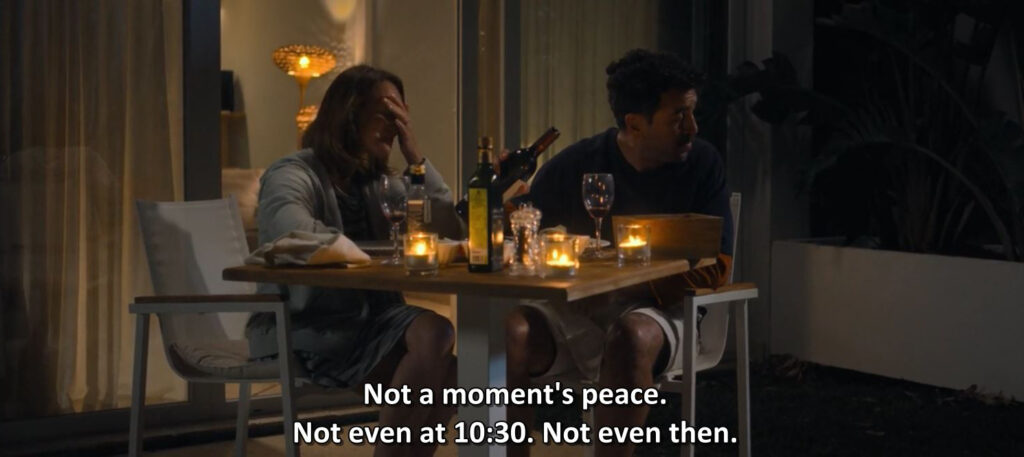
This is just the first reminder of what parenting involves. No matter what time it is or that the parents are on a vacation, children require constant attention.
And there’s more.
In the morning, while Christl is trying to focus on her yoga, Denise begs her to give her ice cream. Christl tells her impatiently that she can’t have ice cream before lunch, unnoticing that this is her daughter’s way to ask for attention. Failing to get some from her mother, Denise crosses the shared garden and comes to talk to Alice who at the time is having a phone conversation about their house renovation. That doesn’t bother Denise who interrupts Alice and asks if she can have a bite of her croissant.

Later that day, while Alice is trying to talk to her husband, she hears Denise begging her father, Romed, to go to the pool. Romed says they are going to the beach but Denise is unhappy about it and starts to yell. Alice and Niklas decide that they had enough with the disturbances and the constant noise and so Niklas goes to the desk to ask for a different house. It so happens that Romed comes to the desk at the same time and Niklas who feels uncomfortable asking to change the house in front of him, lets it go.
They go to the beach. Alice sits by herself trying to relax, but Denise comes to talk to her.
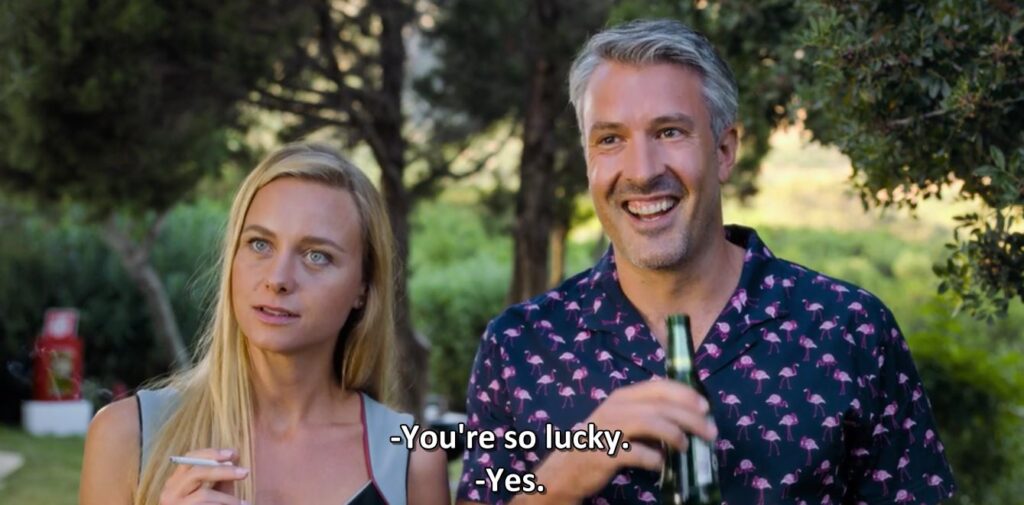
In the afternoon the two couples are talking in the garden. Christl and Romed ask Alice and Niklas if they have kids and they say no. ‘You’re so lucky!” says Christl and Romed immediately doubles down on that. A second later, Denise is calling her mother to come quick and she won’t stop until Christl comes. The adults’ conversation is over when the toddler says so.
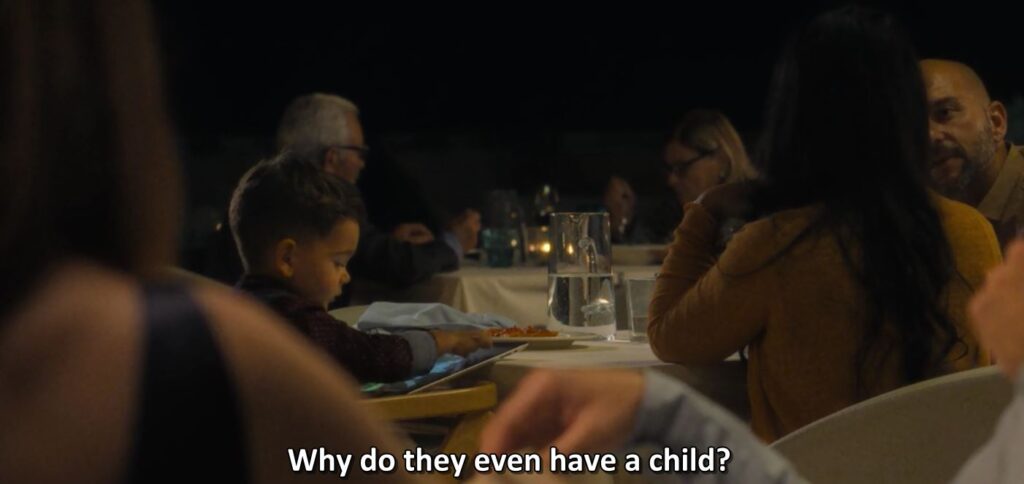
In the evening, Alice and Niklas are trying to have a nice quiet dinner in a restaurant, but they are bothered by a video game’s beeping sounds of a child in the table next to them. The child’s parents are not bothered by the noise their child is making and hardly pay attention to him at all.
Alice is saying: “Why do they even have a child?”
Niklas: “Well at least the parents can have a normal conversation that way. They probably envy us right now.”
Alice: “Yeah Maybe.”
On the next day, after a tennis match with her husband, Alice is trying to enjoy a piece of chocolate but Denise knocks on her door asking for some attention. She tells Alice that she is sad today. Alice asks why and Denise replies that you can’t always know why. Then she asks for some chocolate.
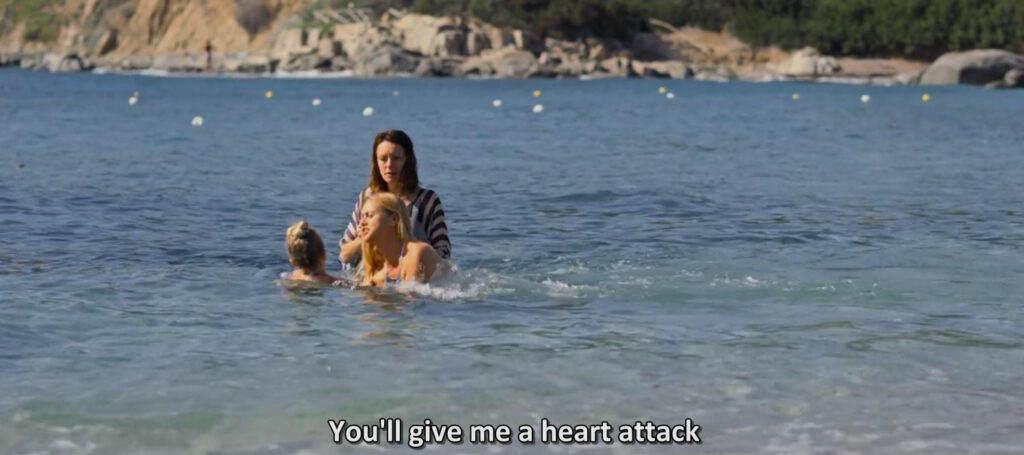
Later, again at the beach, Alice is trying to relax but Denise is asking her to play with her. They play in the sand. Denise takes Alice’s sunglasses and runs into the ocean. Alice chases her and the glasses break. They are expensive. Alice is furious. Christl rushes into the ocean, grabs Denise and says “One day you’ll give me a heart attack” because Denis went into the water without water wings.
I “bother” you with these seemingly marginal moments precisely because they are not. These everyday moments were placed in the film as an important reminder of what parenting entails. For example, that it is difficult to relax because children demand attention almost all the time, that children are sometimes sad and it is not always clear why, that children sometimes destroy valuable things, and that parenting is accompanied by a lot of anxiety about the fate of children.
Meanwhile, in a quite stereotypical male conversation, Romed tells Niklas that he has a wine cellar in the house and that this is his kingdom. “if I want my peace, then I go in there. All alone, no one else. It’s great. I get why you don’t want kids.”

Act Three – Antinatalism
If Denise makes the case that not having children is not such a terrible thing, her brother David makes the case that having children can be a very terrible thing.
David is a gloomy isolated teen, always walking around with earphones on and wearing a T-shirt with the inscription: ‘Asphalt Is My Only Friend’. He tells Alice that the only beautiful thing in life is music, and ‘if you pull out my earphones I will pull out your lungs’.
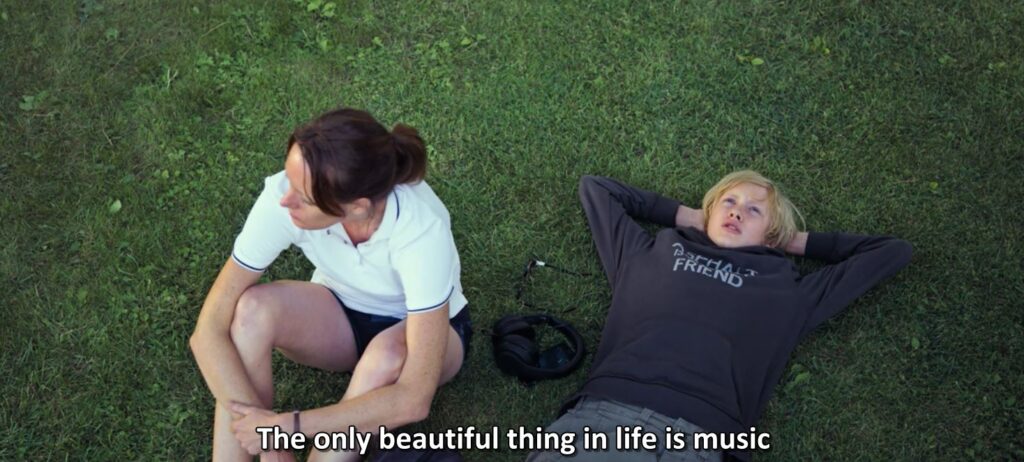
Romed asks David if he wants to come swimming and David replies that he doesn’t like swimming. Romed suggests that they would play tennis and David replies that he doesn’t like tennis. When Romed then suggests mountain climbing David puts back his earphones and ignores his father.
Alice overhears Romed and Christl having the following conversation about David:
Romed: “What did the boy do today?”
Christl: ‘He was at home. He said he studied.”
Romed: “I just can’t get through to him. I’m about to lose my patience. I’m telling you.
At his age, I got only A’s in school. I played soccer, tennis, I helped Dad at work during the summer.”
Christl: “You can’t compare yourself to him.”
Romed: “Why not? He isn’t a kid anymore.”
Christl: “He is. He’s only 13.”
Romed: “I never got to go on vacation. He’s indoors, hasn’t even seen the sea.
I would at least take his phone away, but I have no say.”
Christl: “Come on, don’t be like that. It’s just a phase.”
Romed: “I hope so.”
Christl: “And we all went through it. You too. He’ll get over it.”
But he doesn’t.
In the morning David is found unconscious at the pool. He took every pill from the medicine bag and went into the pool. He is taken to the hospital and is in a state of coma for a while.
David’s suicide attempt not only ended Alice and Niklas’s vacation, but also their pursuit of creating children. It made them finally make peace with not having children.
So what starts off as what seems to be a drama about a childless couple after four failed attempts of IVF who becomes sad with every brief encounter with children, evolves into a film advocating the childfree option through Alice’s closer encounter with Denise, and ends up being quite antinatalist with a closer encounter with David, the lonely and depressed teen who tried to kill himself, an event that functioned as an eye opening experience for Alice and Niklas, realizing that this is surely not what they wanted.

Until a certain point, this film seems like a good advocator of the childfree notion at most. But the story of David changes things. That people can’t have some quiet peaceful time at a restaurant, or the beach, not to mention in their houses, is an important point to make, and indeed it’s very popular among many childfree communities. However, this is insufficient to constitute a firm antinatalist argument. Noisy, spoiled, attention seeking children (even if not entirely by their own fault) who don’t allow even one moment of peace is surely a very sufficient reason to never want children, but not necessarily for it to be immoral to create children. On the other hand, the fact that creating a lonely, disinterested, depressed and miserable person is always an option, is definitely a sufficient and a very strong reason for procreation to always be unethical.
You cooked again