
Hannah’s Arrival
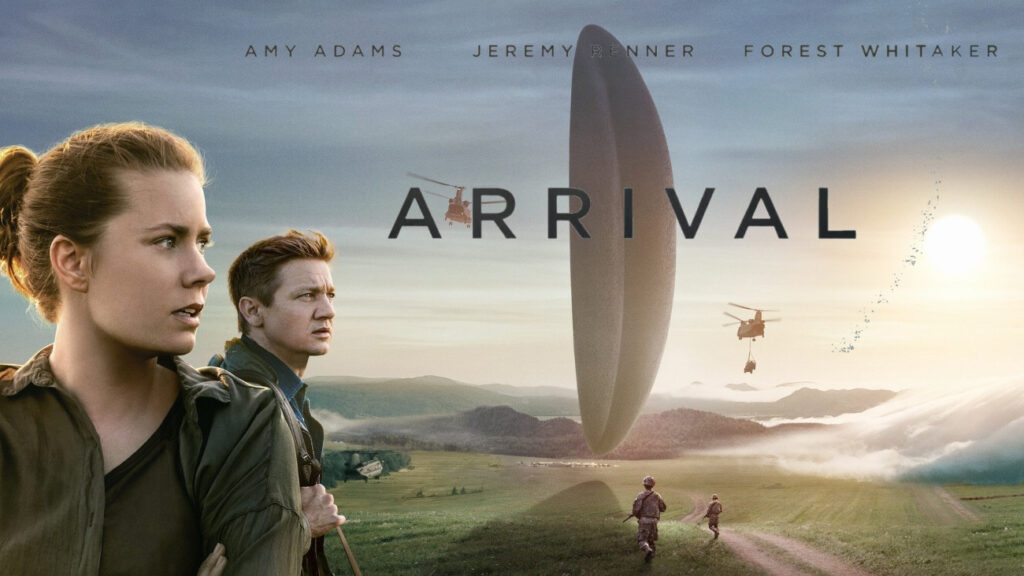
The following is a review of the movie Arrival from an antinatalist perspective. Given that the film’s plot is revealed in this text, if you have not seen the movie and intend to, please read this review after watching it.
Like most science fiction films, Arrival is not really about beings from other planets or humans meeting beings from other planets, but rather about humans meeting other humans on Earth, or meeting themselves in all kinds of crossroads in life.
The basic plot of Arrival is: twelve spaceships land at twelve different locations around the world. One spacecraft lands in Montana, and after the US military fails to communicate with the extraterrestrials, a linguist expert called Louise Banks, and a physicist named Ian Donnelly are recruited to help figuring out what the aliens’ intentions are.
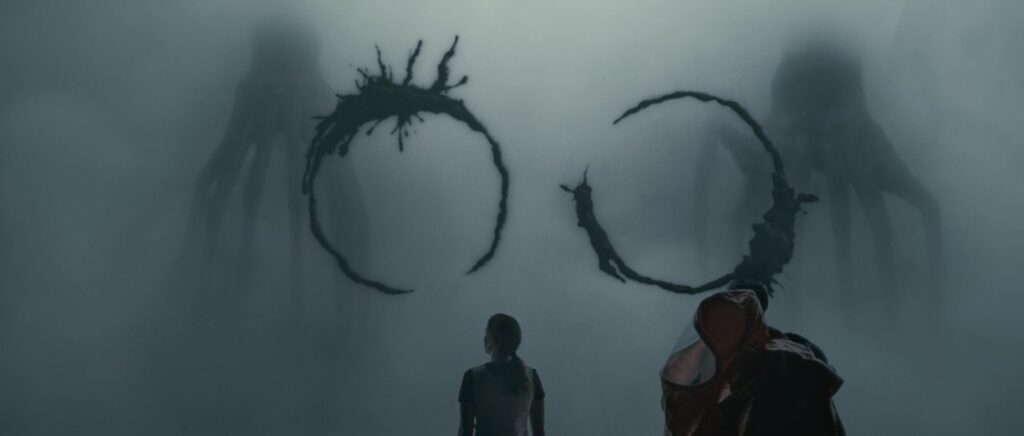
The extraterrestrials try to communicate using a written language (they draw circular marks with some ink-like substance they produce), which Louise and Ian rack their brains to try to interpret. At the same time, similar efforts are being made in the other countries where the extraterrestrials have landed.
Following a misinterpretation by Chinese linguists who interpreted the aliens’ answer to the question of why they came to Earth as ‘use weapon’, China stopped attempts to communicate with the aliens, and stopped sharing information on the matter with other nations. China also provided the extraterrestrials with a 24-hour ultimatum – leave Chinese territory or we will destroy you. Pakistan, Russia and Sudan soon joined in the Chinese ultimatum.
Louise, who interpreted the extraterrestrials’ response as ‘use tool’, managed to convince the Chinese general to withdraw the ultimatum and share the information they had with other countries, so that all human research teams could put together all the pieces of information collected from all the extraterrestrials, assuming that this was the only way to understand their message.
Therefore, one of the main ideas and messages of the film is that only through global cooperation and communication, using language, patience and empathy, and not reckless unilateral actions, can humanity survive.
Another central theme in the film is the relationship between time, memory and language.
Louise managed to change the Chinese general’s mind by calling him on his private phone and telling him a sentence that his wife had told him before she died. Louise was able to know the general’s private number and what to say to him to convince him, because the tool that the extraterrestrials offered humanity is a different perception of time. The idea here is that, unlike all written human languages, the alien written language is semasiographic. And unlike speech, a logogram is not time-dependent, it is not directed forward or backward. Linguists call this “nonlinear orthography” so following the Sapir-Whorf hypothesis, which is the theory that the language we speak determines how we think, and affects the way we perceive everything (which was of course intentionally mentioned in the film), since the alien language is nonlinear, so is their perception of time. So, once they have mastered the extraterrestrials’ language, humans begin to perceive time as the extraterrestrials do, and are therefore able to see the future because it is no longer linear for them either.
And this idea relates to what I see as the central theme of the film, which is certainly my main interest in this review, which is of course reproduction.
The film begins with what appears to be Louise’s recollection of her daughter Hannah dying of an illness in her early teens. So as far as we know, Hannah’s death occurred before the events of the film. However, viewers also receive evidence to the contrary as the film progresses.
During her research, Louise begins to have what appear to be flashbacks. The more she learns about the alien language, the more flashbacks she has, and they all somehow relate to her daughter (except for the one where the Chinese general gave her his private phone number and told her about the sentence his wife said to him on her deathbed). After one of her flashbacks, Louise says to one of the extraterrestrials, “I don’t understand. Who is this child?” even though the person she sees in this flashback is Hannah. The alien replies, “Louise sees future.”
Another clue is given through a flashback of a conversation Louise has with her daughter:
Hannah: Are you gonna leave me like Daddy did?
Louise: Hannah, honey, your daddy didn’t leave you. You’re gonna see him this weekend.
Hannah: He doesn’t look at me the same way anymore.
Louise: That’s my fault. I told him something that he wasn’t ready to hear.
Hannah: What?
Louise: Well, believe it or not, I know something that’s going to happen.
I can’t explain how I know. I just do.
And when I told your daddy, he got really mad. And he said I made the wrong choice.
Hannah: What? What’s going to happen?
Louise: It has to do with a really rare disease.
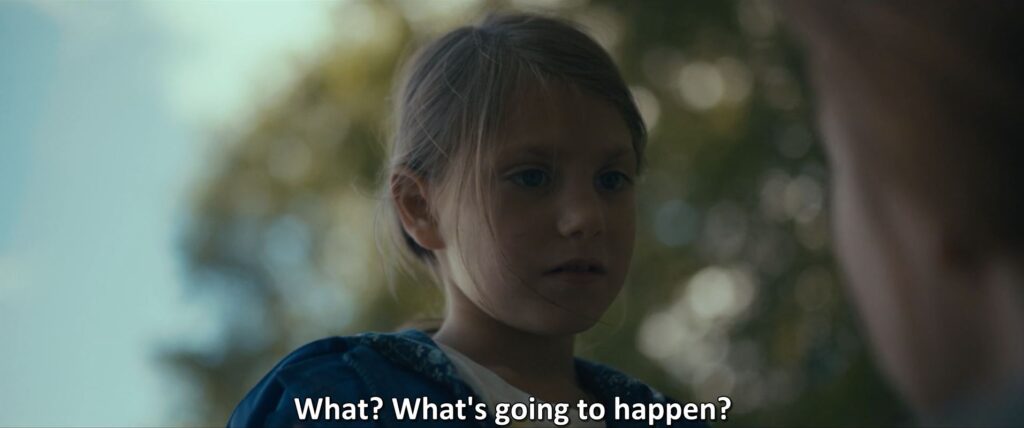
This conversation is happening despite that at some point Louise tells Ian that she is single, not that she had a child who died and a partner who left her because she told him something he didn’t want to hear.
Of course, it is possible that for some reason Louise decided to hide this from Ian, and it is possible that for some reason she didn’t recognize her own daughter, but the real reason Louise told Ian that she was single is because at that point she was single, and she didn’t recognize her own daughter because at that point Hannah wasn’t born yet.
At the end of the film, it is revealed that Hannah’s father is actually Ian and that his relationship with Louise began the day the extraterrestrials left. So contrary to the impression we viewers got from the opening scene, and from Louise’s flashbacks, in fact, all the events of the film took place before Hannah was born. Louise’s flashbacks were actually not memories but visions of future events, they are not memories of the past but of the future.
And this is where the antinatalist perspective comes into play.
From the moment she began to understand the alien language, Louise was able to see time in a non-linear way, and so she knew in advance that she would marry Ian, that they would create a new person together, that Hannah, the person they created, would fall ill with a serious illness, and die at a very young age, and that Ian would decide to leave her after she told him that she knew all this in advance and chose it anyway.
Using the tool she received from the aliens, Louise knew in advance what would happen to her daughter since she was created after the aliens left. She knew about her daughter’s illness. She knew about all the suffering her daughter would go through. She knew that she would die. She knew about Ian’s reaction to her knowing all this in advance, and she made this decision anyway. This is a very cruel decision towards her daughter and her husband.
Unfortunately, people are allowed to make cruel decisions about their own lives, or it is at least debatable if they may or may not, but they should not make cruel decisions about the lives of others, and that should not be up for debate.
In the last minute of the film, Ian asks Louise: “You wanna make a baby?”
Before she answers, Louise, who knows exactly what the outcome of fulfilling this desire will be, reflects on some moments of Hannah’s life such as running in a field, playing with clay, being held by her dad, and then she smiles and says “Yes. Yeah.”
Louise did not reflect on several other moments in Hannah’s life such as all her pain, all her frustrations, her anger, her deep sense of unfairness, her hospitalizations, her father leaving, the fact that her father did not look at her the same way from a certain point, her dying, her father’s grief.
Louise did not ask Ian ‘You wanna make a baby despite that she would get very sick, suffer very much, and die very young?’ And she didn’t ask Hannah if she even wanted to be created, if she wanted to become seriously ill, if she wanted to suffer a lot, experience her parents’ separation, her father’s leaving, and to die very young.
Two minutes earlier in the film, Louise says, “Despite knowing the journey and where it leads, I embrace it, and I welcome every moment of it.” And she asks Ian: “If you could see your whole life from the start to finish, would you change things?” So this film can be viewed as echoing the Nietzschean notion of eternal recurrence, or at least that we should take life as it is without trying to change even the bad things in it. Except that it’s not just her life that’s at stake. Louise created a new person, of course without that person’s consent, and it is her will to embrace the journey and welcome every moment of it, not her daughter’s. Louise can decide that she welcomes every moment of her suffering, not every moment of her daughter’s suffering.
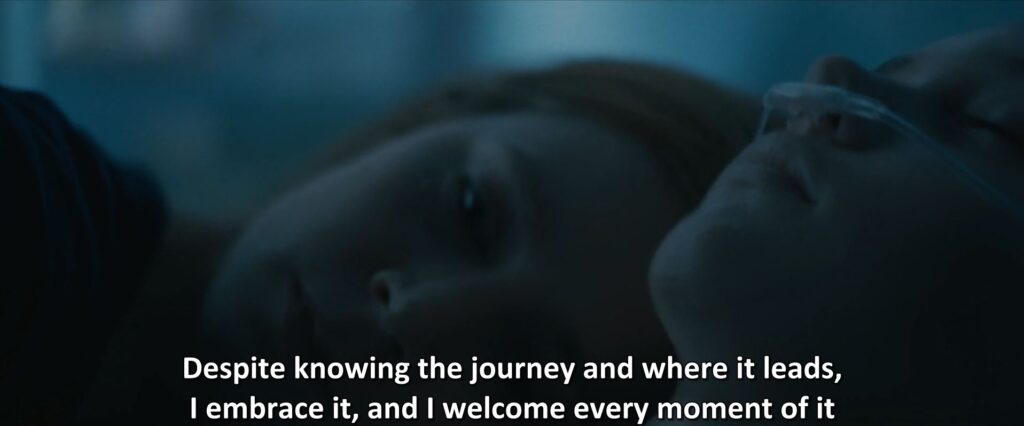
Hannah’s life, her illness, her parents’ separation, the feeling of losing her father at a very young age, all the suffering she has gone through, are all just a platform for Louise’s experiences. Louise may decide that she is willing to go through all of this, and not give up her experiences with her daughter and husband even though she knows what will happen, but she has no right to make these decisions for others. She had a choice, they did not.
Some interpret the film as deterministic, but according to its creator, this is not the message he wanted to convey, and for him, the characters have free will. At the same time, regardless of your personal interpretation of the film in the context of free will, or your views on free will in general, the message of the film is certainly that despite knowing the journey and where it leads, we must embrace it, and welcome every moment of it. This is despite the fact that people in general, and certainly those who decide to reproduce, not only live their own lives, but in many ways, also dramatically affect the lives of others.
The ethical position Louise embodies, be it a very cruel and wrong decision, or, if you are more inclined to the deterministic interpretation of the film, then standing behind and embracing a very cruel eventuation, is anyway wrong and cruel.
Antinatalists rightly argue that because no matter how hard parents try to make sure their children are happy, there are endless ways in which life can easily turn from happy to miserable – with little, and sometimes nothing, that parents can do about it – reproduction is always morally wrong. This argument, commonly called the risk argument, does not require a view that life is inherently bad, but rather that a bad life is always a possibility. And no prospective parents can ever know whether the person they are creating will have a bad life. Even people who generally think that life is good agree that existence is dangerous. There is always a risk that the created person will endure extremely miserable life, and one should not take risks with the life of another.
However, in the case of Arrival, it is not even a risk but a preordained fact. Yet this is the decision of the protagonist, and so the message coming out of the film regarding how people view the creation of new people is strong and clear.
Anyone who decides to create a new person decides to take a risk on someone else’s life.
The reason I view Arrival as a film that is primarily about reproduction is because it reflects how people make such critical decisions for others when they create them. The reason I see this film as a very pro-natalist film is because it rules in favor of this intrinsically wrong situation, even in cases where it has to be very, very clear against it.
Arrival is a science fiction drama, not a true story, but the concepts related to procreation that it represents are real.
While we try to convince people that looking at the present and the past is absolutely enough to determine that creating people is morally wrong, unfortunately, for some people, on a principled level, even a look into a future that is supposed to be the realization of their worst nightmares is not enough to make them abandon their desire to reproduce.
Therefore, Arrival is indeed not a dystopian film like many other science fiction films, but not because it is actually romantic and optimistic, but because it does not describe a dystopia but rather what is already our bleak reality here and now on Earth.
Louise did not ask Ian ‘You wanna make a baby despite that she would get very sick, suffer very much, and die very young?’
…Louise can decide that she welcomes every moment of her suffering, not every moment of her daughter’s suffering.
…While we try to convince people that looking at the present and the past is absolutely enough to determine that creating people is morally wrong, unfortunately, for some people, on a principled level, even a look into a future that is supposed to be the realization of their worst nightmares is not enough to make them abandon their desire to reproduce.
-Hear hear! nicely put