
True Detective False Antinatalist
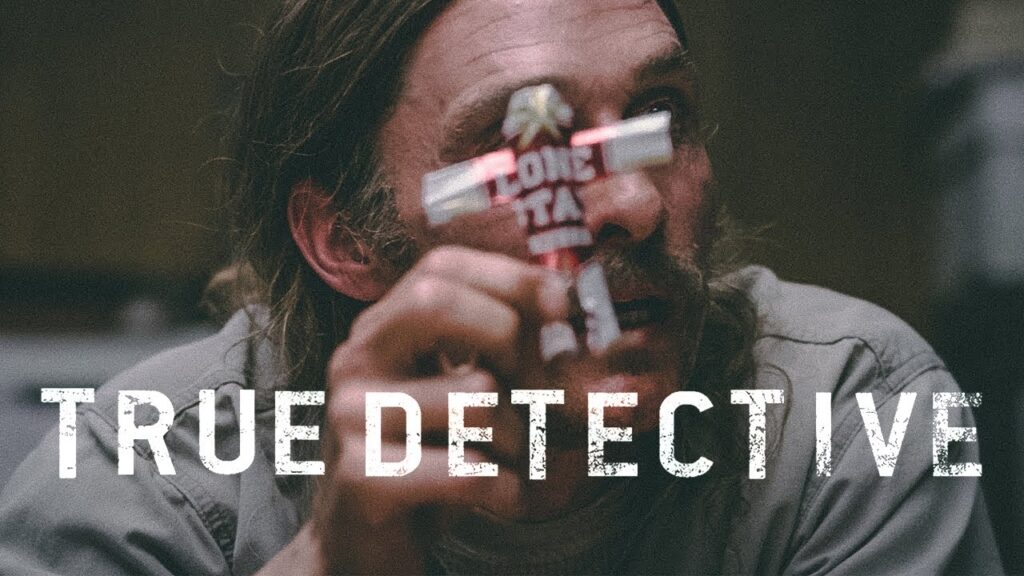
In this section, I will address some movies and TV shows that I think are interesting to review from an antinatalist perspective. This will not reflect my personal taste in movies and TV shows, or my recommendations for movies and TV shows that I think contain antinatalist content, but rather ideas about reproduction that are expressed in a few selected movies and TV shows that I think are interesting to address.
I don’t think there is a more appropriate TV show than the first season of True Detective to launch this series of pop culture reviews from a critical perspective on reproduction.
True Pessimist and Antinatalist
I suppose there’s no need to explain why the show, or at least one of its two leading characters, is considered an iconic fictional embodiment of pessimism and anti-natalism. I suppose there’s no need to elaborate on the plot either. So I’ll just say that it’s a crime drama that tells the story of Marty Hart and Rust Cohle, two detectives who thought they had solved the ritual murder of a young woman in Louisiana in 1995, only to discover in 2012 that a very similar murder had occurred, and so the killer may still be on the loose.
But I suppose there’s a need to explain why I think this show is actually anti-antinatalist. And to do that, there’s no need to tell the story from the beginning, just skip straight to the end.
It’s important for me to point out before diving into this, that the first season of True Detective, alongside and despite everything that will be claimed later in this text, undoubtedly presents pessimism and antinatalism in an explicit, coherent, serious and relatively thorough manner. Certainly much more than any other show I’ve ever seen. And that’s certainly an achievement.
Rust Cohle is not a secondary character who helps advance the plot, or advance another character in the show, but rather is one of two leading characters in a series that is outstandingly based on two leading characters. In fact, the show’s creator, Nic Pizzolatto, said that with the exception of the brief first scene in the last episode in which viewers get a brief glimpse of the Yellow King’s point of view, every other scene in the series contains one of the two leading characters of the series. The story progresses when they are in the scene, and viewers encounter other characters only when one of the two leads is in the scene, meaning that in this series, the main characters are very central. And one of them is extremely pessimistic and antinatalistic. I’ve never seen such a dominant character that a pessimistic worldview is so dominant in their character.
Here are some reminders of some of Rust’s pessimistic and antinatalist claims throughout the series:
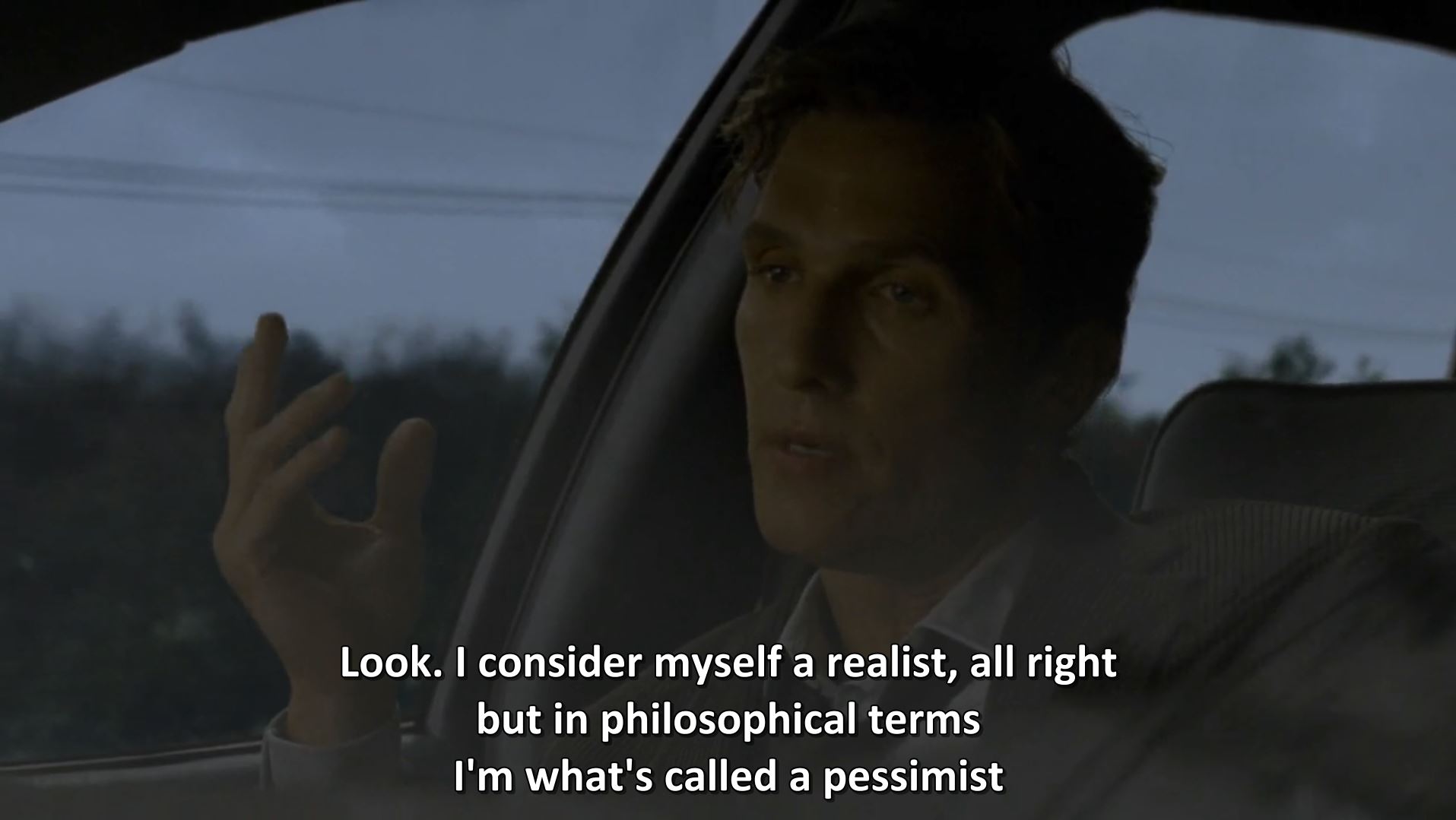
“I consider myself a realist, all right, but in philosophical terms, I’m what’s called a pessimist.” (Episode 1 – The Long Bright Dark)
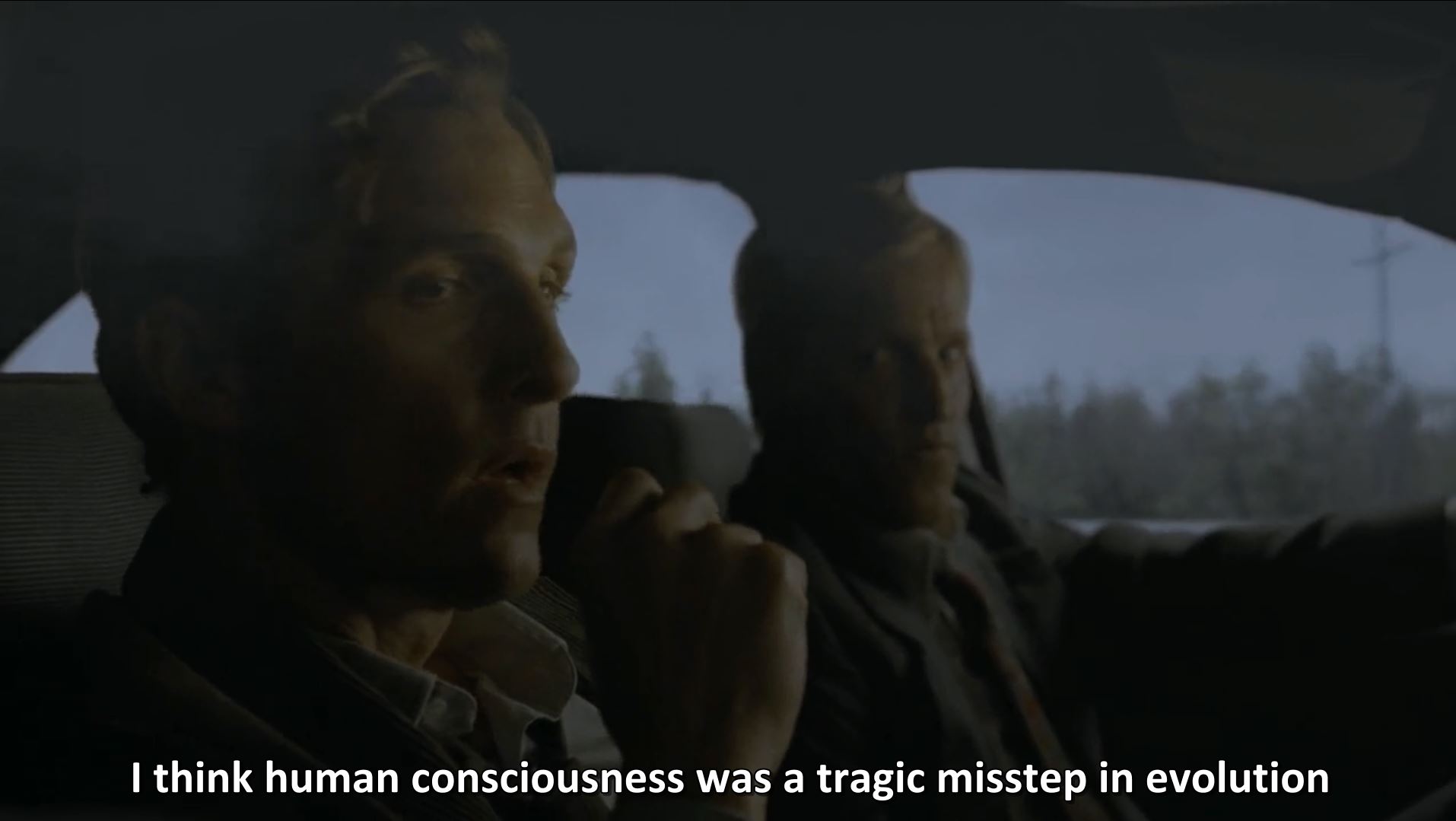
“I think human consciousness was a tragic misstep in evolution.
We became too self-aware. Nature created an aspect of nature separate from itself.
We are creatures that should not exist by natural law.
We are things that labor under the illusion of having a self, this accretion of sensory experience and feeling, programmed with total assurance that we are each somebody when, in fact, everybody’s nobody.” (Episode 1 – The Long Bright Dark)
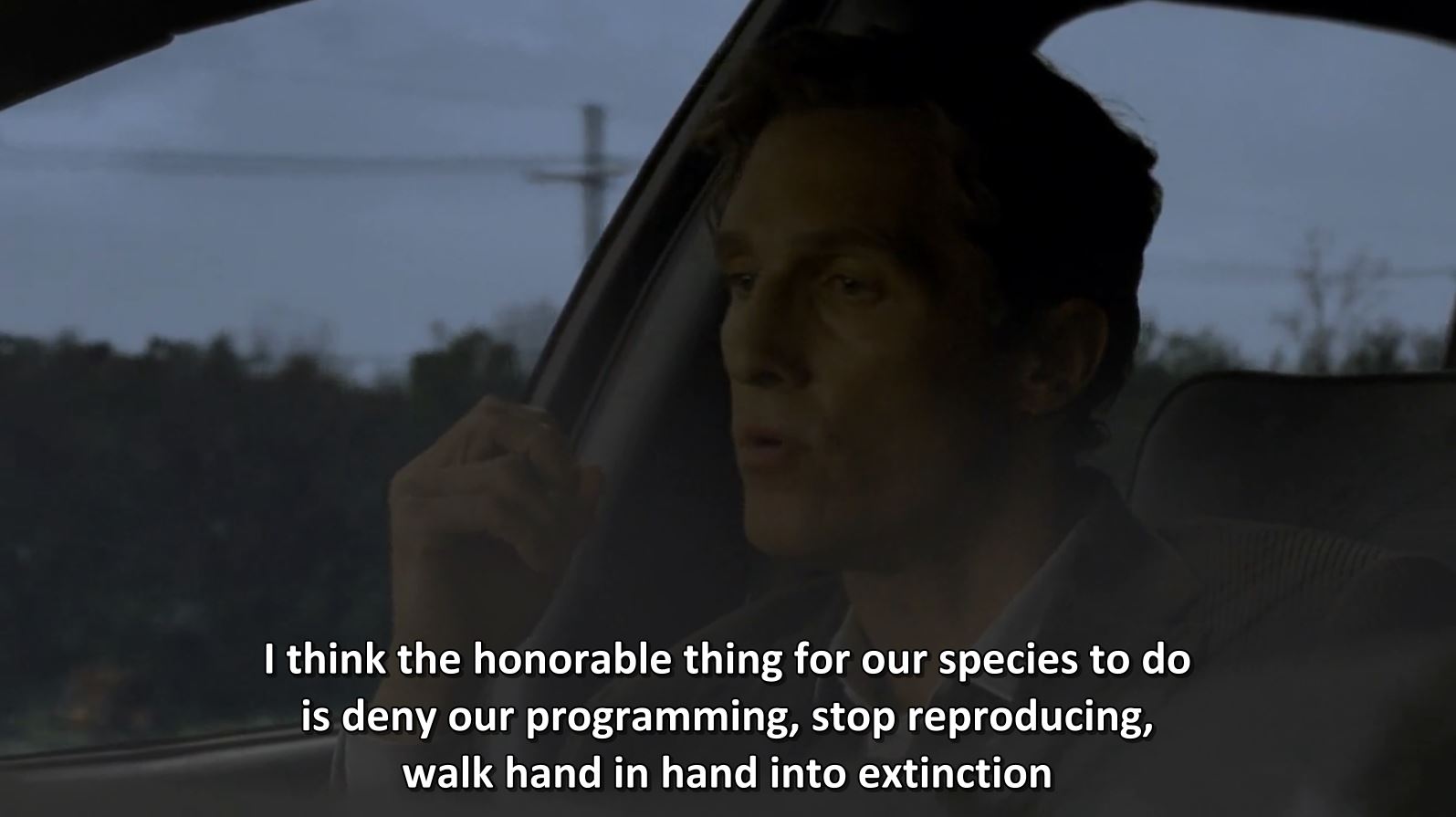
“I think the honorable thing for our species to do is deny our programming, stop reproducing, walk hand in hand into extinction, one last midnight, brothers and sisters opting out of a raw deal.” (Episode 1 – The Long Bright Dark)
After being asked by his partner Marty what’s the point of getting out of bed in the morning? He replies: “I tell myself I bear witness, but the real answer is that it’s obviously my programming, and I lack the constitution for suicide.” (Episode 1 – The Long Bright Dark)
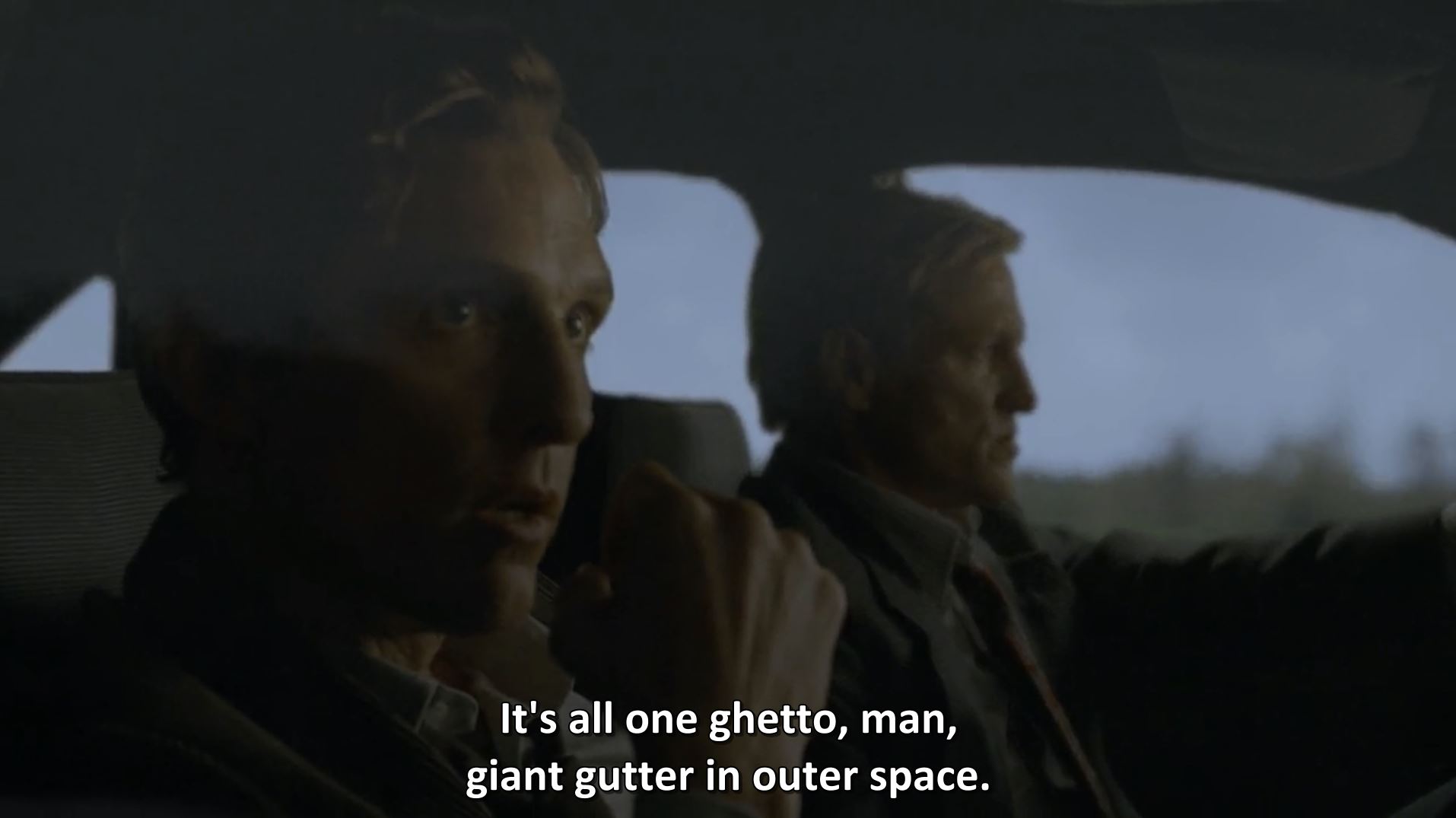
“It’s all one ghetto, man, giant gutter in outer space.” (Episode 1 – The Long Bright Dark)
“You know how I think about my daughter now? You know what… what she was spared?
Sometimes I feel grateful.
Doctors said she didn’t feel a thing. Went straight into a coma, and then, somewhere in that…blackness, she slipped off into another, deeper kind. Isn’t that a beautiful way to go out? Heh!
Painlessly, as a happy child. Hmm.
Yeah, trouble with… dying later is you’ve already grown up. Heh! Damage is done. It’s too late.” (Episode 2 – Seeing Things)
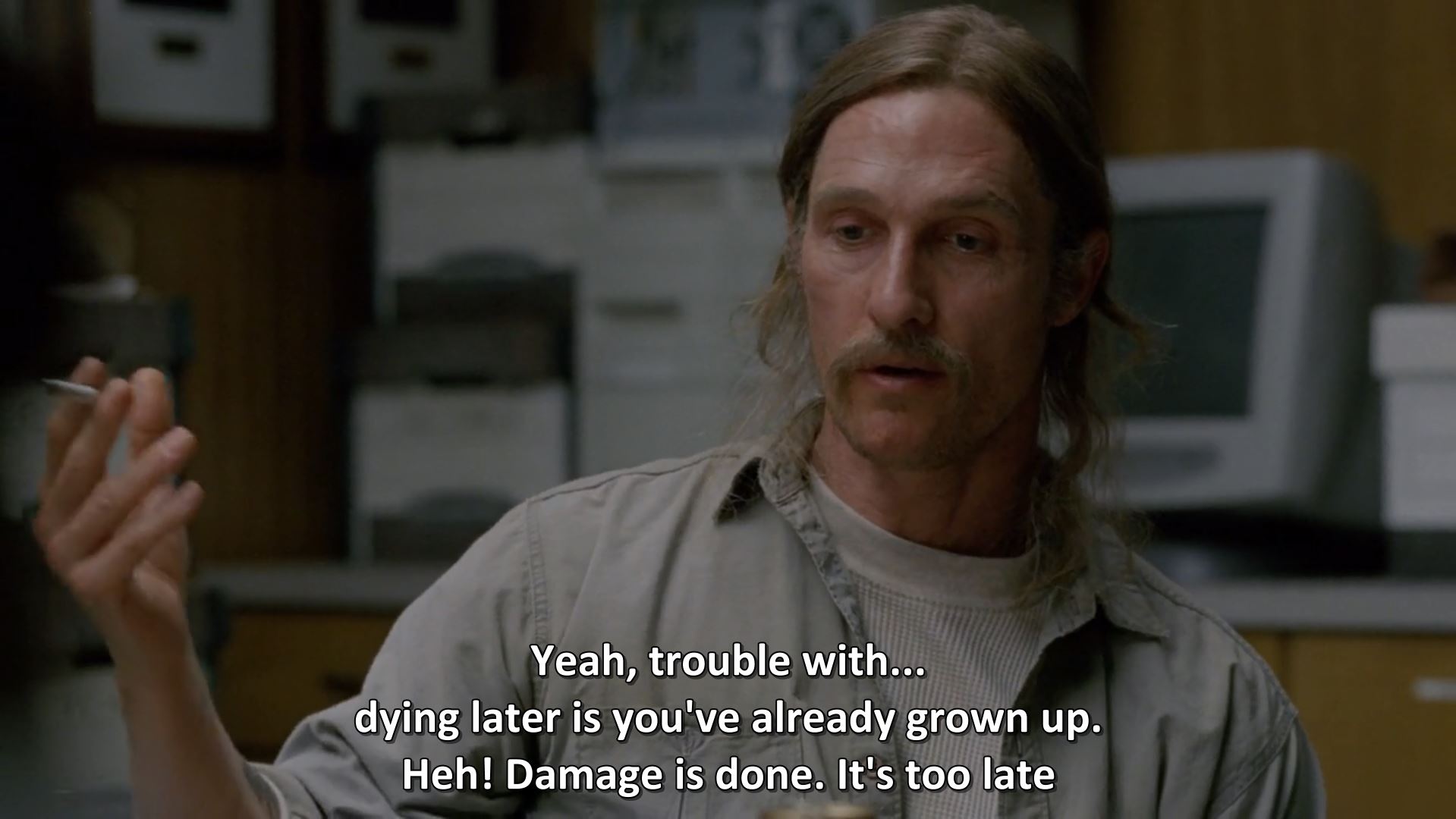
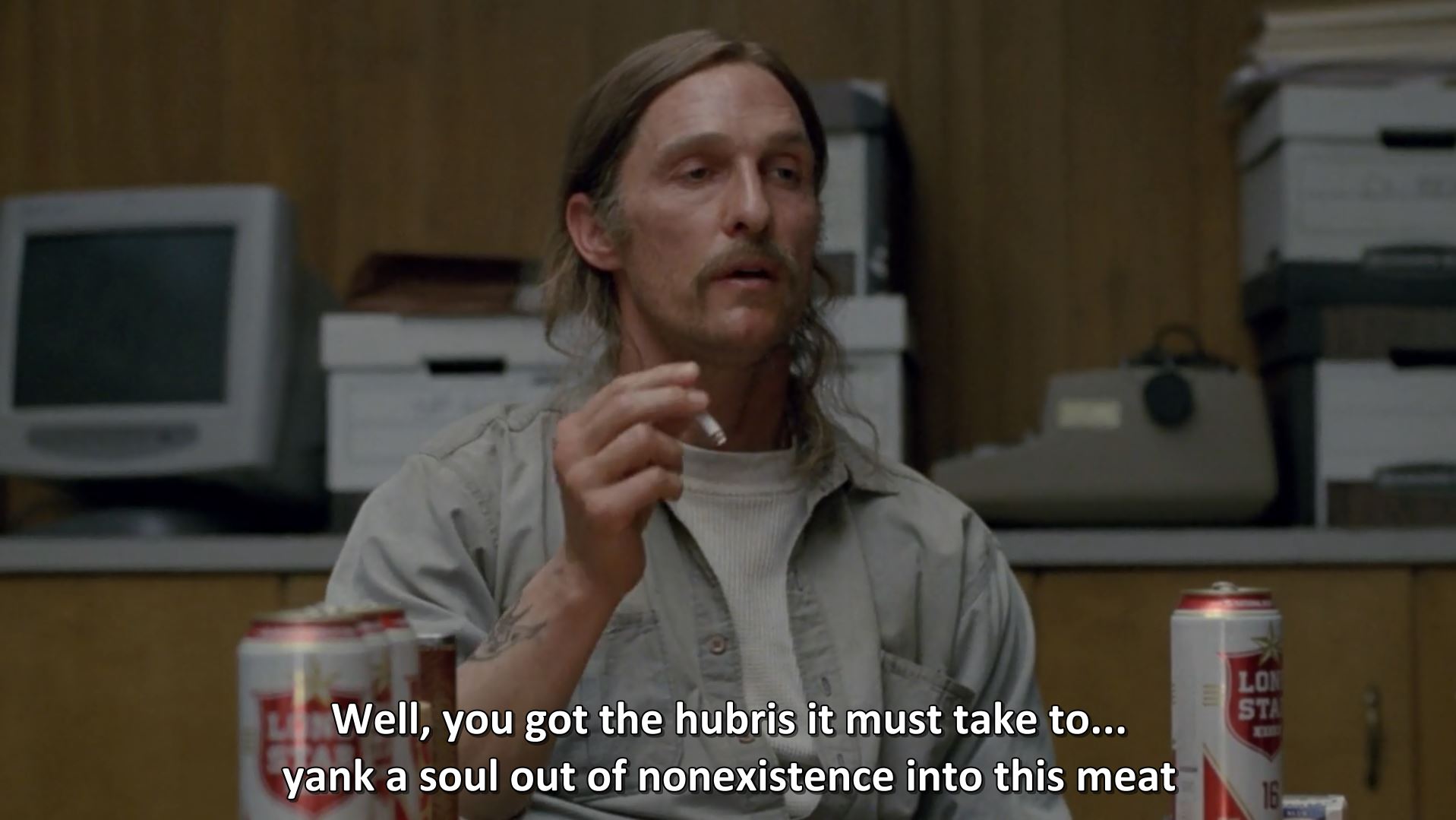
“You got kids? Mmm.
Well, you got the hubris it must take to…yank a soul out of nonexistence into this meat. And to force a life into this thresher. And as for my daughter, she, uh…she spared me the sin of being a father.” (Episode 2 – Seeing Things)
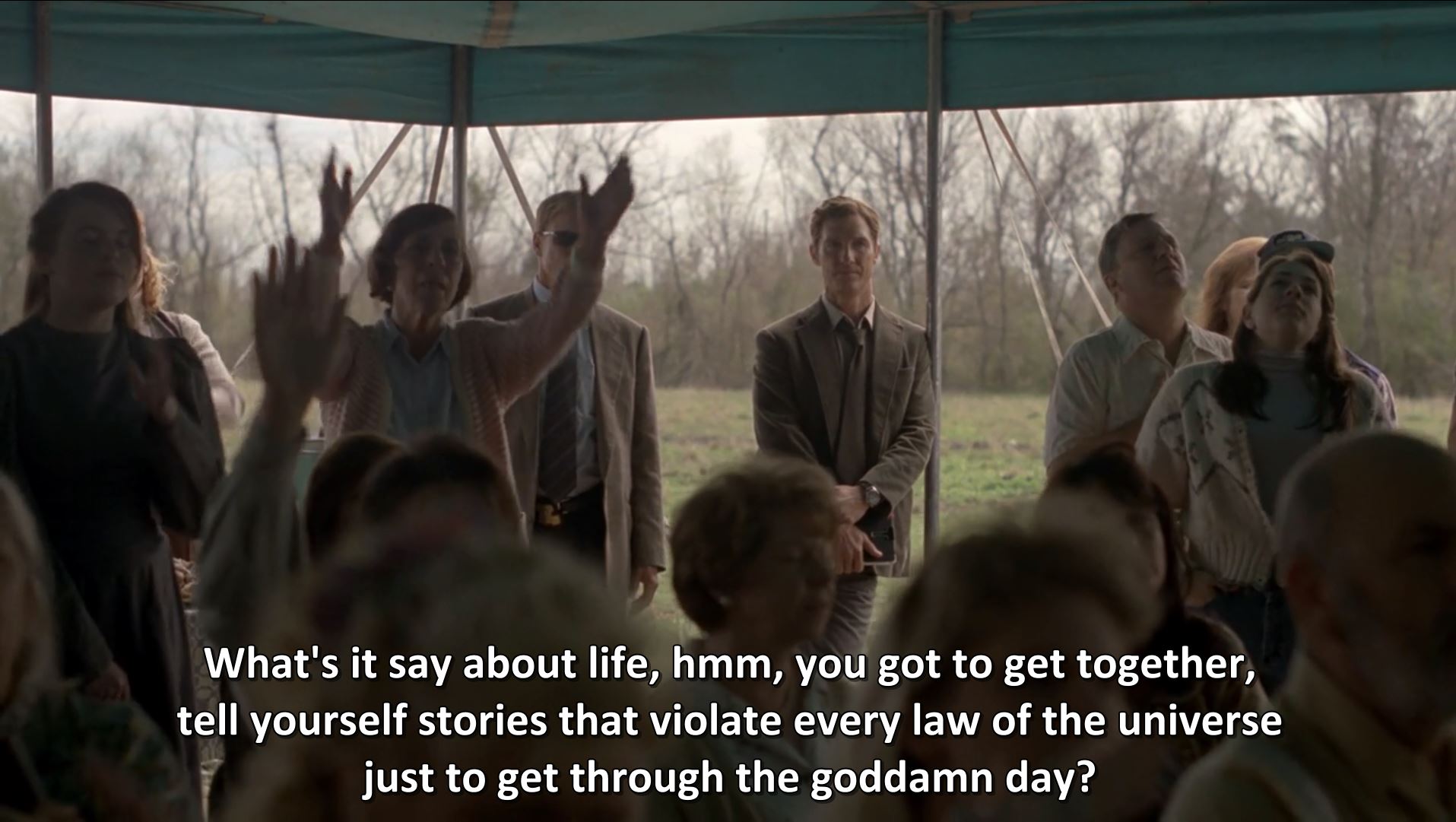
“What’s it say about life, hmm, you got to get together, tell yourself stories that violate every law of the universe just to get through the goddamn day?
What’s that say about your reality, Marty?” (Episode 3 – The Locked Room)
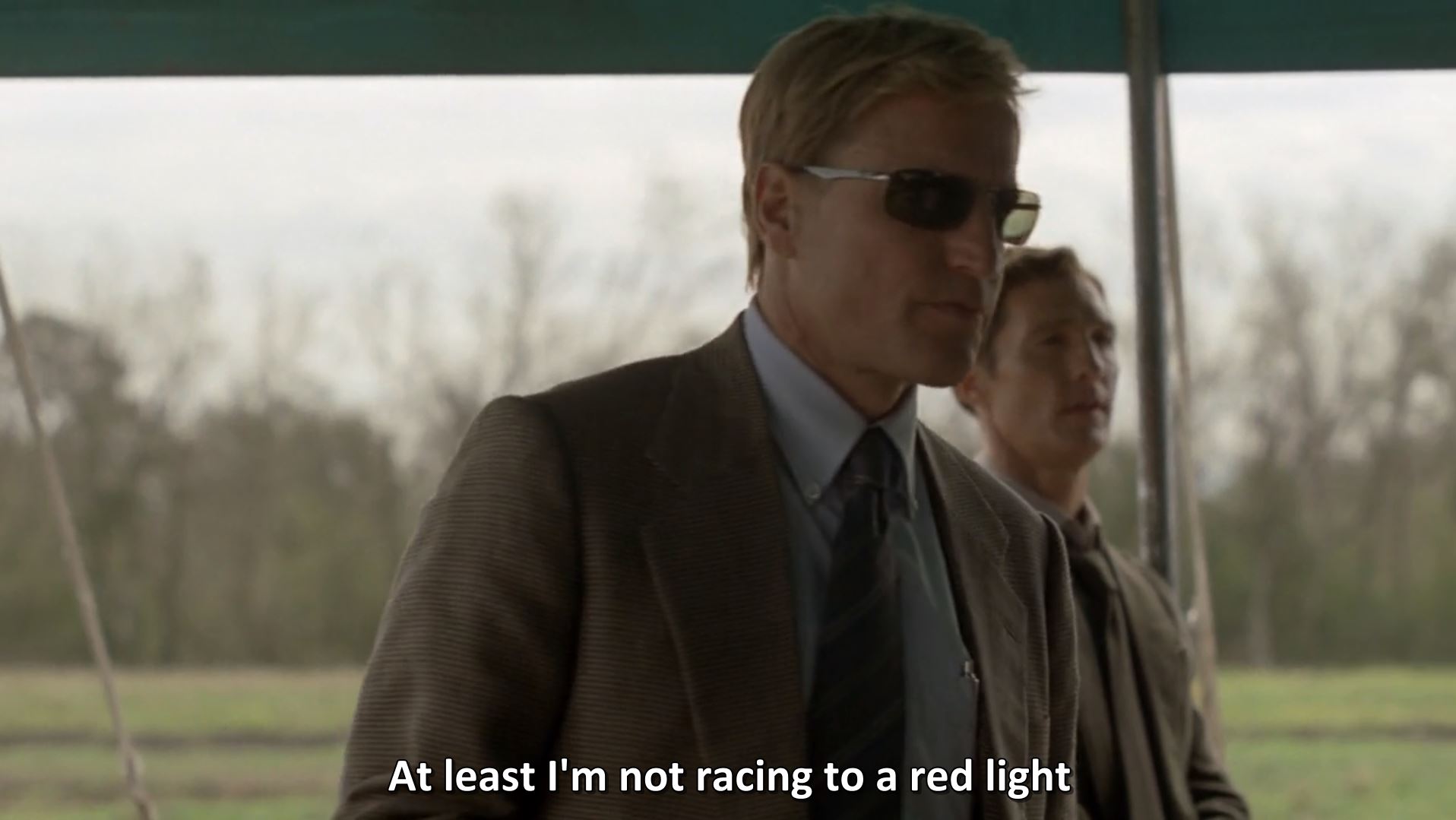
“At least I’m not racing to a red light.” (Episode 3 – The Locked Room)
“See, we all got what I call a life trap, this gene-deep certainty that things will be different, that you’ll move to another city and meet the people that’ll be the friends for the rest of your life, that you’ll fall in love and be fulfilled.
Fucking fulfillment, heh, and closure, whatever the fuck those two… Fucking empty jars to hold this shitstorm, and nothing is ever fulfilled until the very end, and closure…
No. No, no. Nothing is ever over.” (Episode 3 – The Locked Room)
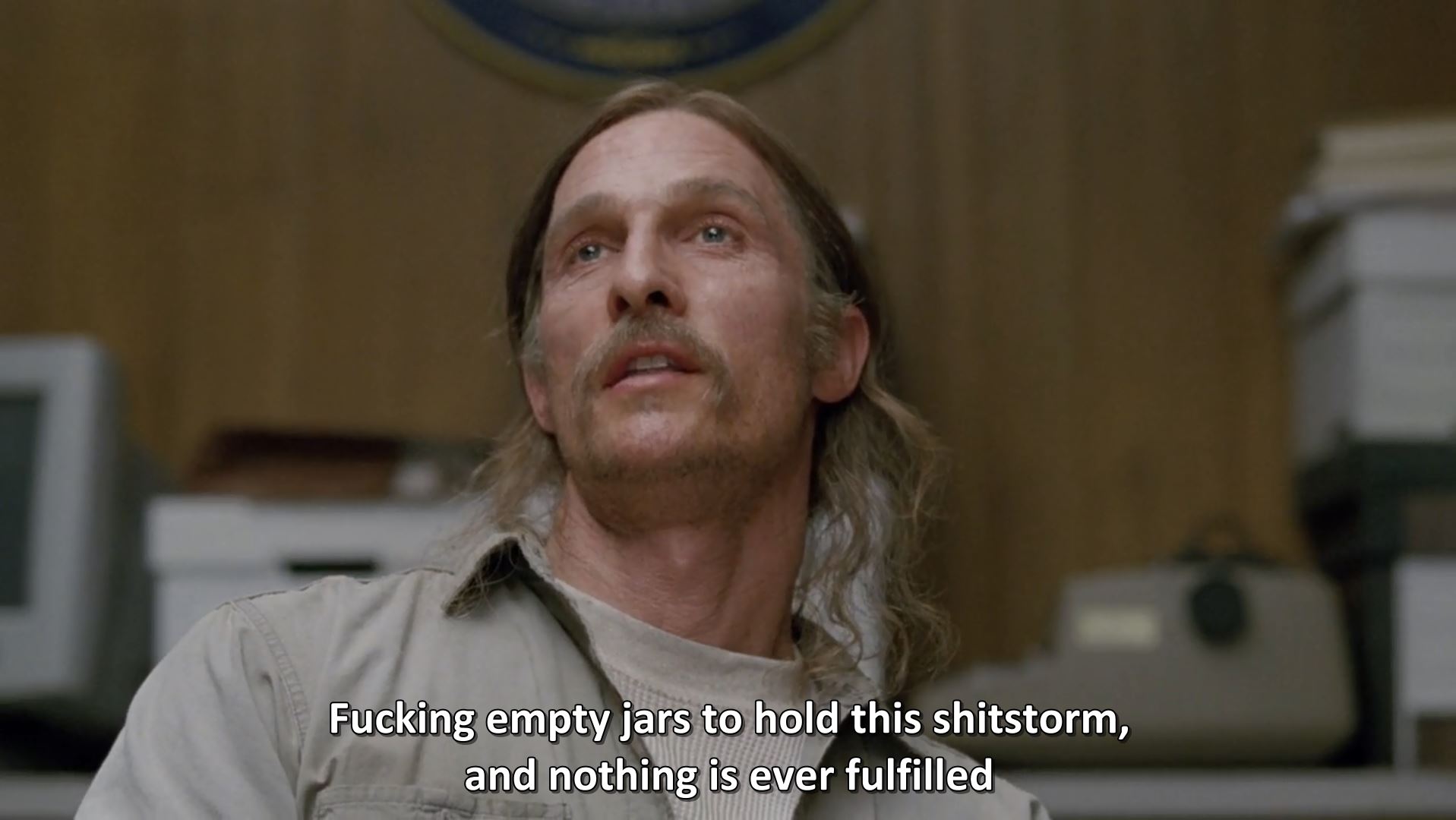
“People. I’ve seen the finale of thousands of lives, man… young, old.
Each one is so sure of their realness, that their sensory experience constituted a unique individual with purpose, meaning… so certain that they were more than a biological puppet.
Well, the truth wills out, and everybody sees once the strings are cut, all fall down.” (Episode 3 – The Locked Room)
“Each stilled body so certain that they were more than the sum of their urges, all the useless spinning, tired mind, collision of desire and ignorance.” (Episode 3 – The Locked Room)
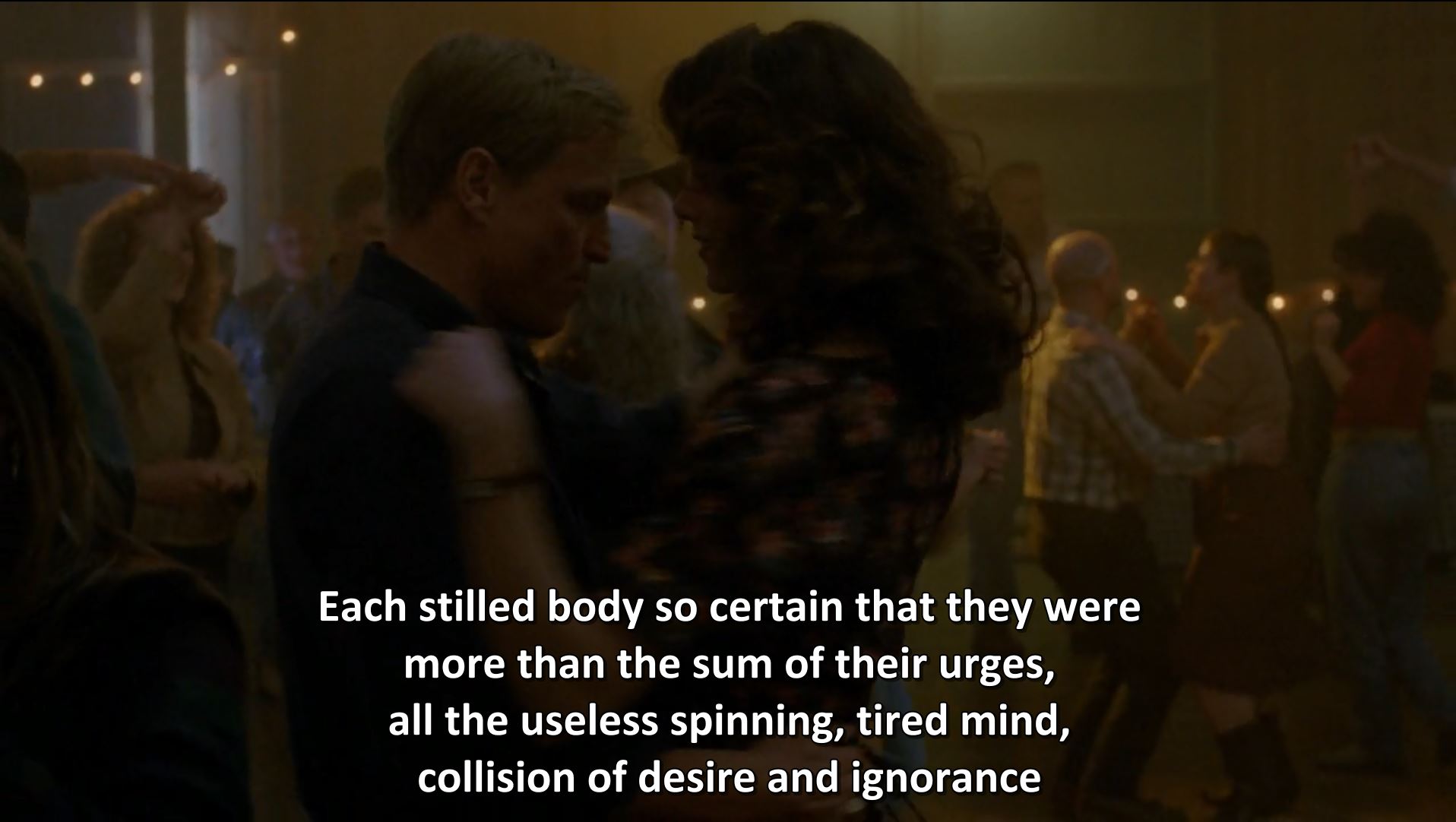
“This is what I mean when I’m talking about time and death and futility.
There are broader ideas at work, mainly what is owed between us as a society for our mutual illusions.
14 straight hours of staring at DBs, these are the things you think of.
You ever done that? Hmm? You look in their eyes, even in a picture. Doesn’t matter if they’re dead or alive. You can still read them, and you know what you see?
They welcomed it, mm-hmm, not at first, but right there in the last instant. It an unmistakable relief, see, because they were afraid and now they saw for the very first time how easy it was to just let go, and they saw… In that last nanosecond, they saw what they were, that you, yourself, this whole big drama, it was never anything but a Jerry-rig of presumption and dumb will and you could just let go finally now that you didn’t have to hold on so tight… to realize that all your life… you know, all your love, all your hate, all your memory, all your pain… it was all the same thing.
It was all the same dream, a dream that you had inside a locked room, a dream about being a person…
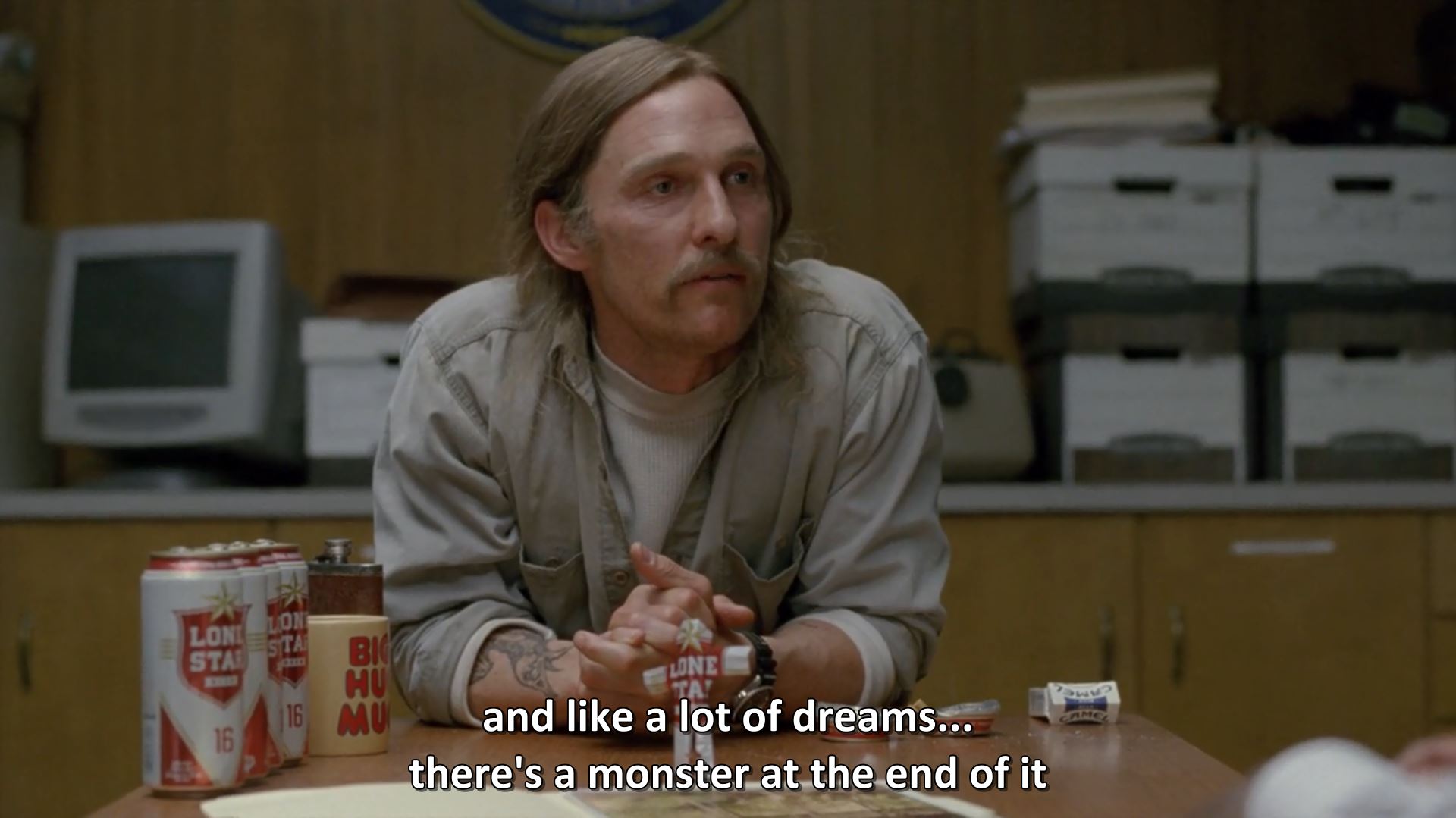
and like a lot of dreams…there’s a monster at the end of it.” (Episode 3 – The Locked Room)
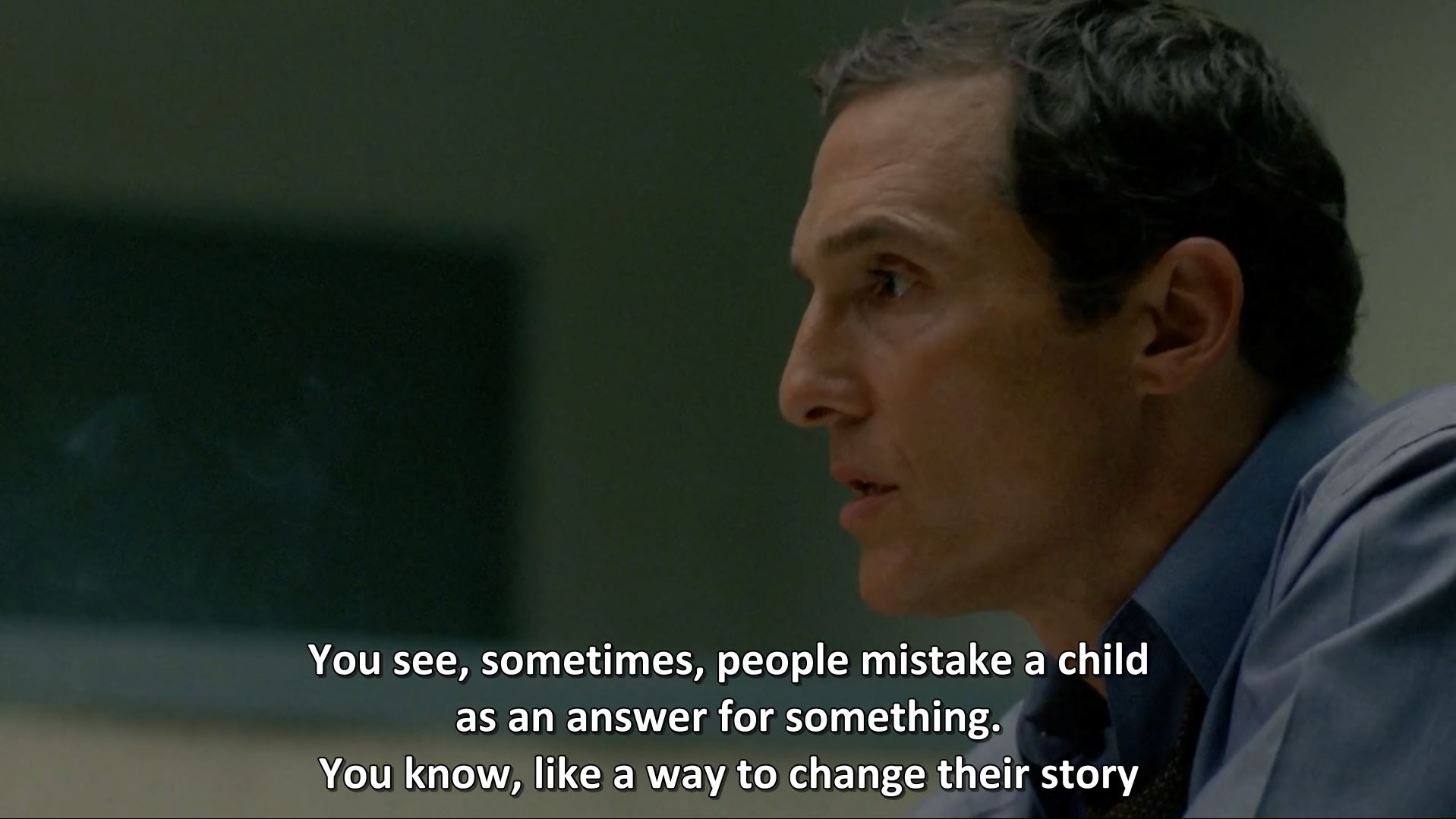
“You see, sometimes, people mistake a child as an answer for something.
You know, like a way to change their story.” (Episode 6 – Haunted houses)
I deliberately use many quotes despite supposing that most of you are familiar with most of them, and that is to show how deep, thorough, well based, highly grounded Rust Cohle’s pessimism and antinatalism is. And therefore couldn’t be utterly deserted because of one moment of “a vague awareness in the dark”, while being in coma.
So with all the praises, it is hard to conceal the deep disappointment, if not a sense of betrayal by the repudiation of all the ideas expressed in the above quotes, in the finale of the show.
False Pessimist And False Antinatalist
On the surface, it might seem a bit harsh and judgmental to claim that less than ten minutes of the show could do so much damage to so many ethically important ideas that were unfolded throughout the rest of its seven and a half hours, but the end of this series, in my opinion, managed to do just that.
Here is the transcript of the show’s ending scene:
“Rust: There was a moment… I know when I was under in the dark that something… Whatever I had been reduced to, you know, not even consciousness. It was a vague awareness in the dark… And I could… I could feel my definitions fading.
And beneath that darkness, there was another kind, it was deeper, warm. Like a substance. I could feel, man.
And I knew… I knew my daughter waited for me there. So clear… I could feel her. I could feel them. I could feel a piece of my pop, too. It was like I was a part of everything that I ever loved.
And we were all, the three of us, just fading out.
And all I had to do was let go. And I did. I said, “Darkness, yeah, yeah” And I disappeared.
But I could still feel her love there. Even more than before. Nothing… Nothing but that love.
And then I woke up.
Marty: Hey, uh… Didn’t, uh… Didn’t you tell me one time, at dinner, once, maybe, about… You used to… You used to make up stories about the stars?
Rust: Yeah, I was in Alaska under the night skies.
Marty: Yeah. You used to lay there and look up. Yeah. At the stars?
Rust: Yeah. You remember, I never watched a TV till I was 17, so there wasn’t much to fucking do out there, besides walk around, explore. And… And then look up at the stars and make up stories.
Marty: Like what?
Rust: I’ll tell you, Marty, I’ve been up in that room, looking out those windows every night here.
Just thinking it’s just one story. The oldest.
Marty: What’s that?
Rust: Light versus dark.
Marty: Well, I know we ain’t in Alaska but it appears to me that the dark has a lot more territory.
Rust: You know, You’re looking at it wrong, the… sky thing.
Marty: How’s that?
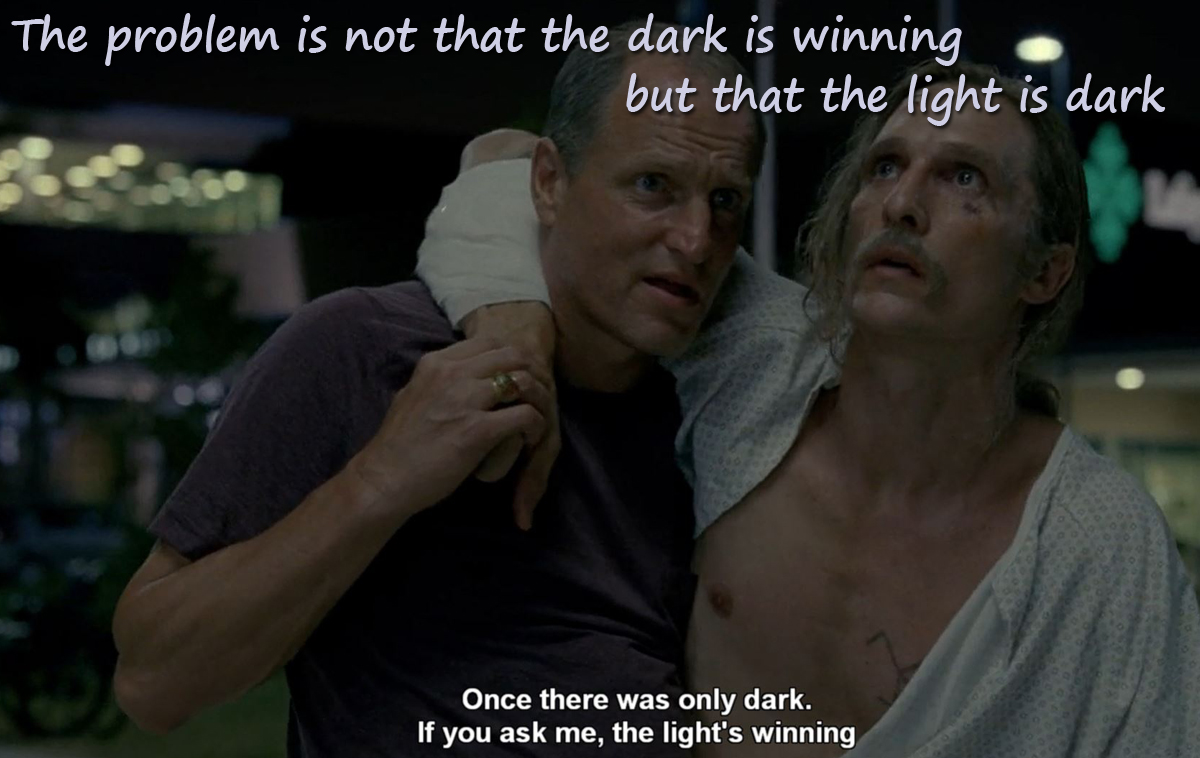
Rust: Once there was only dark. If you ask me, the light’s winning.”
It’s very disappointing that by the time there’s finally such a deep, sharp, and well-reasoned antinatalist and pessimist character on a successful TV show, all it takes to crack it is for it to crack one series of crimes, albeit extremely horrific, but still just one series of atrocities in a world full of horrors of all kinds and scope.
This move drastically reduces Rust Cohle from a very determined and well-reasoned anti-natalist and pessimist to someone with a personal interest. Although we know that he was deeply affected by the death of his daughter, which also led to the end of his marriage, his arguments were very comprehensive, sharp, well-founded and impersonal but principled and universal. The series’ final scene ignores all of the profound claims and observations about existence that Rust makes throughout the show, and suddenly it all turns into a kind of private journey of revelation.
But philosophical pessimism is, should be, and practically was when it came out of Rust’s mouth, general and impersonal. It is a philosophical view of life in general, of life in itself, not of the life of a specific person. So there is no reason why Rust’s worldview should change so radically, if not completely, as a result of the death of one evil person, or of his own near-death experience. The world is still the same as it was before Rust fell into a coma. Other evil people still do great harm to many other people.
Rust Cohle may have succeeded in defeating one person who is evil incarnate, but all his victims over the years have not. And Rust knows that. How is this a case of light triumphing over darkness when darkness has tortured who knows how many children for decades?
One case of victory over one person who is evil incarnate should not have changed the view of such a conscious and well-founded pessimist as Rust Cohle. It’s much more reasonable for him to think that there’s one less evil person in a world full of evil. Of course, it’s certainly better than a world with the “Yellow King,” but it’s still a very terrible world. Everything Rust said throughout the eight episodes of the series is still true even after one person who is evil incarnate is killed.
The world is certainly less terrible without the “Yellow King” in it, but there’s no reason to look at it differently from a philosophical point of view because all the horrors that the “Yellow King” has committed and will continue to commit, should not have happened in the first place. And of course, all the horrors done by the Yellow King’s family cannot be undone retroactively.
So the killing of the “Yellow King” should not be seen as a victory of good over evil, but rather that some evil deeds that never should have happened if this world really weren’t so terrible will not happen again. And even that is not certain, as only Errol Childress, aka the “Yellow King”, is dead, while the rest of the cult, including other members of the Tuttle family, are free.
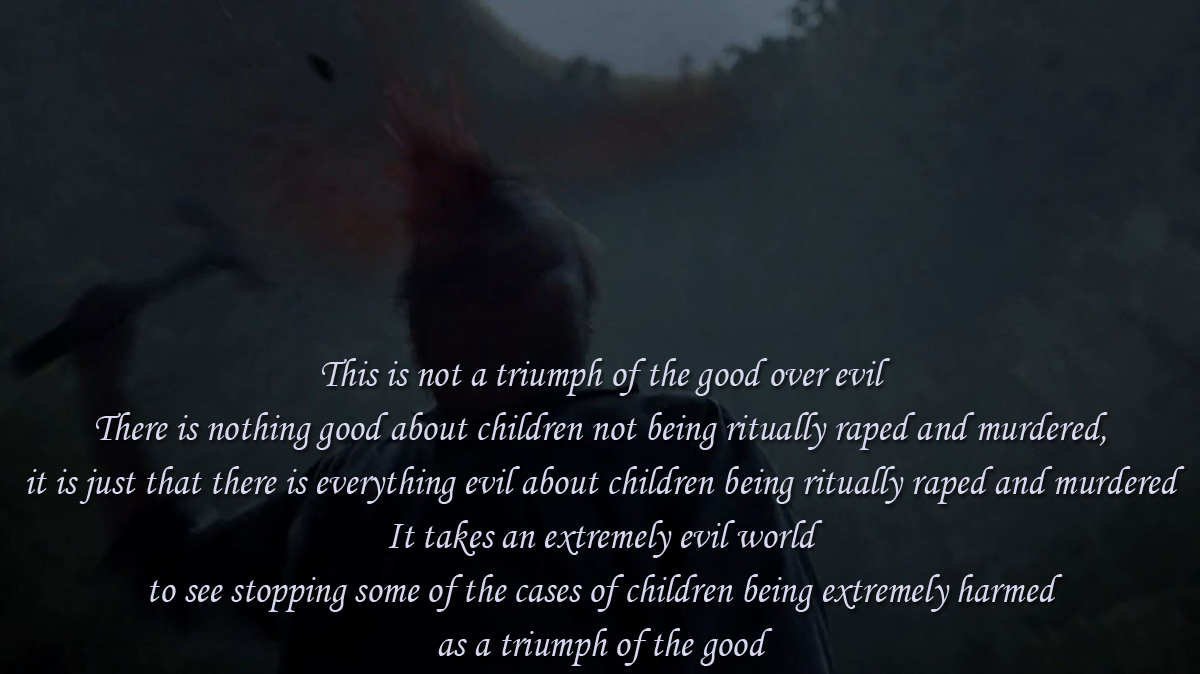
This is not a triumph of good over evil. There is nothing good about children not being ritually raped and murdered, it is simply that there is everything bad about children being ritually raped and murdered (or in any other way). It takes an extremely evil world to see stopping some of the cases of children being extremely harmed as a triumph of the good.
In Episode 3, while standing in the church tent, Rust rhetorically asks Marty: “What’s it say about life, hmm, you got to get together, tell yourself stories that violate every law of the universe just to get through the goddamn day?” So to paraphrase his question, one could ask another rhetorical question: ‘What does it say about life, hmm, that you have to catch one evil person, and then tell yourself stories that the light of the universe shines brighter than the darkness, just to get through the day?’
What kind of pessimist would seriously argue that light triumphs because there used to be only darkness? Any true pessimist understands what it means for there to be light – it means life and all that goes with it, and therefore total darkness is essentially a pessimist’s dream. The problem, as Rust himself has explained sharply and clearly several times throughout the series, is built into and inherent to life.
All of Rust’s claims and observations about existence still hold true in a world without the Yellow King, or with his one moment of “a vague awareness in the dark”. One could even argue that things are even worse when there is love, because as he himself experienced firsthand, love often ends, and sometimes very, very quickly, in his case after only two years. If the only thing that can make up for this pointless and terrible existence is love, however love can end, and so horribly, life is even worse than Rust portrayed it (at least for the seven and a half hours of the series, and with the exception of its last ten minutes).
Rust should not have been affected, certainly not so radically, by his confrontation with the Yellow King or by his vision in which he met his daughter and father while in a coma, for by this point his pessimism was too deep to be shaken so easily, and it was too deeply rooted to suddenly depend on his personal biography.
At no point does Rust sound like a man who is simply depressed and broken, but rather as someone who, although his pessimistic and antinatalist worldview was originally triggered by personal tragedy, it completely took on a life of its own and established a rational stance against life.
A cynic tough-minded materialist who speaks fluent Schopenhauerian for two decades does not become a born again spiritual optimist after a single moment of vision while in a coma.
And the show didn’t necessarily have to end in the same dark mood that it had all along the way. It didn’t have to end with Rust dying, or with him committing suicide after leaving the hospital. The series could even have ended on a less pessimistic note, like Rust and Marty telling each other that at least there are a few less evil people in the world, or something like that. But to have someone like Rust go through such a profound change, especially because of some kind of spiritual revelation, is very inconsistent with everything he is.
An Anti-Antinatalist Show
So, as stated in the introduction to this text, the ending of the first season of True Detective is more than disappointing. At least according to the final scene, this is a series that is essentially anti-antinatalist, and this is because what the final scene actually suggests is that the only thing that can defeat evil, the only thing that makes this pointless existence, this one ‘ghetto’ as Rust calls the world, this ‘giant gutter in outer space’ worth it, is love, and not just any kind of love, but love between parents and their children, like in Rust’s vision in which he was with his daughter and his father.
Of course, we can treat Rust’s such sharp turn as a feeble attempt (which is very unconvincing considering everything we have heard from him so far) to provide the viewers with catharsis. However, this is the character and this is the rapid and abrupt process it has undergone. This is Rust’s final and decisive insight. The final and concluding message of the show is that if we simply learn to look at things correctly, the light seems to prevail.
Yes, there are extremely cruel, ritualistic, pedophile, murderous cults, but there are also loving daughters. For some reason, the final scene doesn’t mention that loving daughters can die at the age of two in a car accident and that cruel, ritualistic, pedophile, murderous cults can operate for two decades without interruption.
More importantly, one of the most outrageous things about Rust’s dramatic turn is that even if such a radical change was believable in the case of someone like him, this kind of insight is reserved only for those who somehow managed to survive the horrors and maintain their sanity. Such insight is irrelevant to the many victims of the Tuttle family who were brutally murdered after being raped. These people just suffered. And they really suffered. And so did their families and everyone who cared about them. They did not get to experience a moment that was nothing but love. They had hatred, pain and suffering.
There is nothing credible about Rust’s “salvation” from pessimism, but even if there was, many others did not get that opportunity. They remained in “the dark” and never came out.
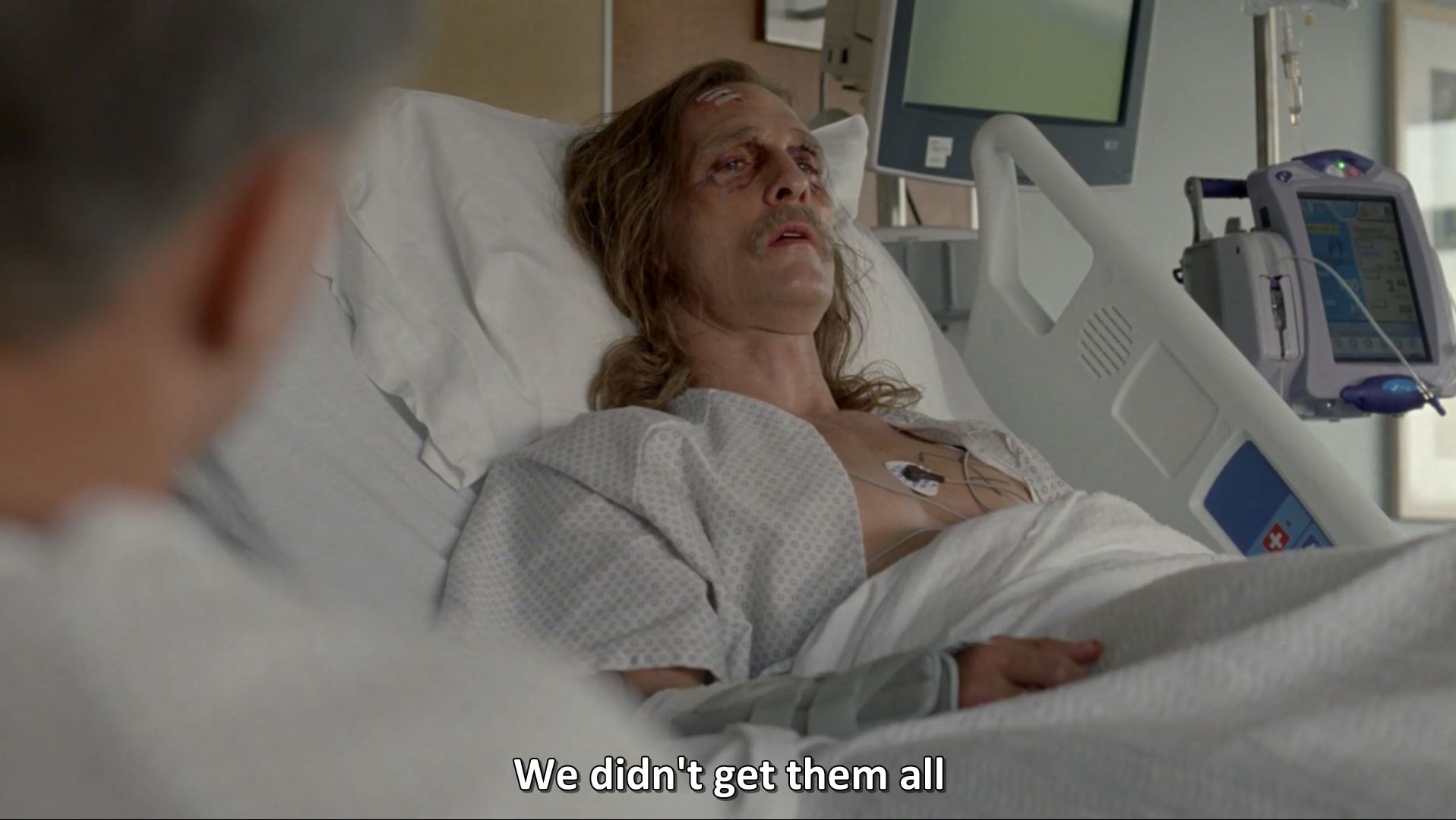
To change such deep and fundamental beliefs as pessimism and antinatalism just because there is a little light in the sky is to perpetuate the darkness. It is perpetuating victimhood of more children by more harms. As stated in a much more authentic line during the final scene, Rust tells Marty, “We didn’t get ’em all.” And Marty replies, “Yeah, and we ain’t gonna get’em all. That ain’t what kind of a world it is, but we get ours.” Rust, of course, understands that there will be more villains and more evil. Maybe other detectives will catch them much faster, maybe they’ll catch them after 17 years like Rust and Marty, or maybe they’ll never catch them, but there will certainly be more victims, and lots of them, and that’s a very strong reason for Rust to maintain his pessimistic, and even more so, his antinatalist, views.
And of course, all the other terrible things will continue to happen in people’s lives. And that brings me to another problem I have with the show in the context of antinatalism, which is that the evil in the show is the ultimate evil. The killers the detectives are looking for are cult members of psychopaths-pedophiles-child rapists-ritual murderers-rich-powerful-corrupt politicians-Satan worshippers. The serial killer named the Yellow King is the embodiment of evil in many ways. He does not represent common evil in real life. This kind of evil is not common. Most evil in life is more casual, everyday, random, accidental, unintentional, unorganized, and unplanned. So my concern is that for many viewers, the presence of such pure evil completely overshadows the common, everyday evil, to the point where it is ignored. In other words, the presence of an abstract expression of pure evil allows for the ignoring of concrete evil in the real world.
However, everyday evil is certainly present in True Detective. The show presents many bad things that happen to all the characters, not just the direct victims of the cult.
There is no need to elaborate on Rust’s misery, but others are miserable as well. At the beginning of the story, Marty is a senior detective, married, has two healthy daughters, lives in a house of his own, is popular with his co-workers, is appreciated by his boss, and has a positive outlook on life. Marty ends the series divorced, has a long-distance relationship with his daughters, is no longer in the police force, is the only employee of a private investigation firm he started, and is emotionally scarred by all the horrors he has witnessed.
Maggie, Marty’s wife, is miserable. Audrey, one of Marty’s daughters, is miserable. Lisa, Marty’s lover, is miserable. And even people we meet only briefly are miserable. For example, Pastor Joel, who in the earlier parts of the show is a dedicated and passionate preacher with a large following, later has a serious breakdown, leaves the church and becomes an alcoholic. Bert, one of Joel’s followers, is a sex offender who probably had many victims who were scarred for life by his actions, and is also a victim of his own mental illness, as some gang members cut off his testicles with a razor in prison.
Several characters in this TV show are drug abusers, including Rust who has a history with drugs. For others, it’s alcohol, including Rust again, and also Marty. Both have drinking problems. There are cases of failed marriages, child abandonment, child neglect, poverty, gangs, trafficking, women exploited in strip clubs and women exploited in the sex industry.
And speaking of the exploitation of women in the sex industry, one of the most disturbing examples of the fact that a lot of bad things happen to all the characters is illustrated in a scene that may seem rather incidental, especially against the backdrop of the cult’s horrors, during which Marty Hart has a brief argument with a woman who runs a ranch for runaway girls where they work as prostitutes. Here’s the conversation:
“Marty: That girl’s not 18. The sheriff know you got underage working here?
Woman: What do you know about where that girl’s been, where she come from? You want to know Beth’s situation, ‘fore she ran out on her uncle?
Marty: There are other places she could go.
Woman: Such holy bullshit from you.
It’s a woman’s body, ain’t it? A woman’s choice.
Marty: Well, she don’t look like a woman to me. At that age, she is not equipped to make those kind of choices. But I guess you don’t give a shit what kind of damage she’s doing to herself, as long as you’re making your money.
Woman: Girls walk this Earth all the time screwin’ for free. Now, why is it you add business to the mix, and boys like you can’t stand the thought? I’ll tell you. It’s ‘cause suddenly you don’t own it the way you thought you did.” (Episode 2 – Seeing Things)
At the end of this conversation, Marty gives this girl some money and tells her to “do something else.” A few years later, he meets her at a phone store where she works. They talk for a bit, and then, in what seems like gratitude on her part for his help, they go to her apartment and have sex. It’s obviously entirely possible that she thinks of Marty as a good person and after meeting so many scumbags her whole life that she actually likes him, or that she’s attracted to him because he’s a cop who can supposedly protect her, or something of that nature, but it’s also entirely possible that she learned from a very young age that in order to get love and attention, she has to give sex. She just doesn’t know other kinds of relationships with men.
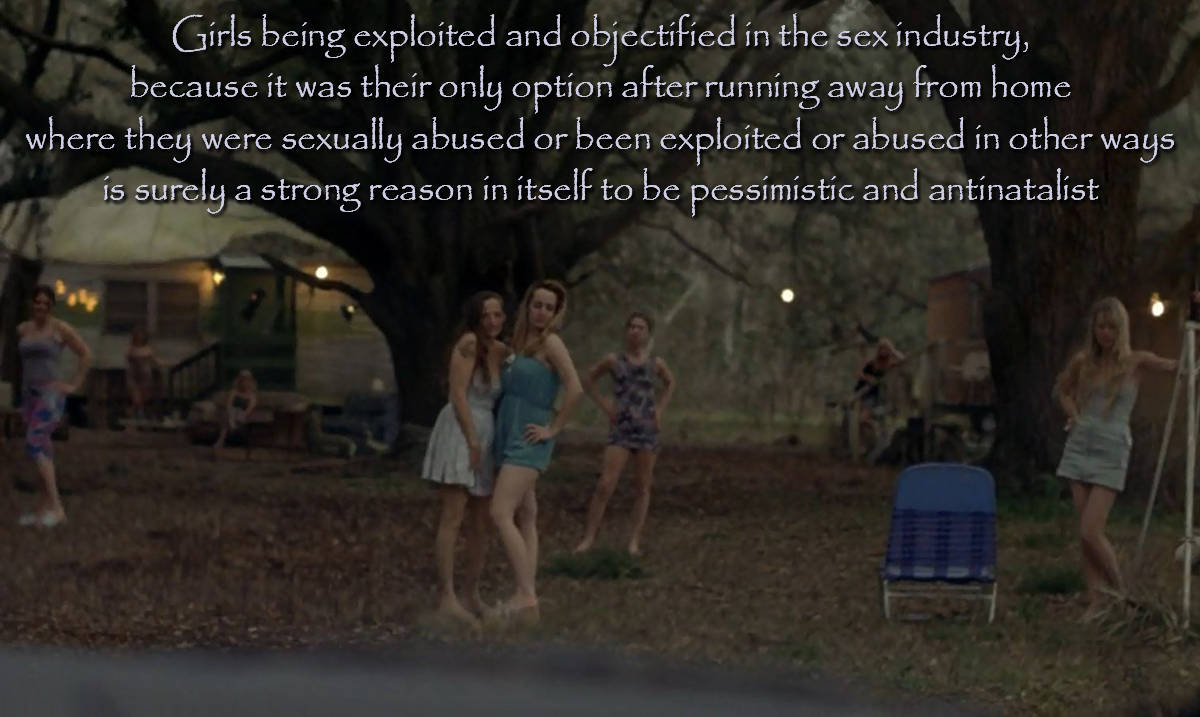
Women who are exploited in the sex industry from such a young age, who come from broken homes where they were sexually assaulted, raped, exploited or beaten, don’t get much screen time in this show, but it’s another human horror that we are faced with throughout it. It’s very easy to just spout clichés like Marty did in that scene, but unfortunately, in real life, for many women, the truth is much closer to what the lady described. And this is the awful reality. Girls being exploited and objectified in the sex industry, because it was their only option after running away from a home where they were sexually abused or exploited or otherwise abused, is surely a strong reason in itself to be pessimistic and antinatalist.
So the characters who are not direct victims of the cult are of course still victims, and they are victims of the much more common horrors of life. They are all miserable in their own way, at their own level of misery. In any case, all the horrors are human horrors. Even the supposed monsters are human.
Some viewers were disappointed that at the end of the show the creators abandoned the supernatural a bit and presented the monstrosity as human. They claim that this is a disappointing shift from what is more commonly seen in the Thomas Ligotti-style cosmic horror genre. They claim that making the monsters human makes them less scary. However, in my opinion, the move away from the supernatural to the natural returns the pessimistic claims and diagnoses, back from the mysterious, delusional world, from iconic evil and monstrosity; back to the real world.
A world where people are capable of this kind of monstrosity is a much scarier and more dangerous world than a world where supernatural monsters exist. It is true that monsters are creatures that are difficult to define, and therefore it is not clear how to stop them. How to beware of them. How to identify them. How to estimate how many of them are out there and etc. However, aren’t all of these questions also relevant in the case of humans?
Really interesting essay. Just a small stylistic note: there are two sentences where a repeated word (“dominant” / “crack”) slightly interrupts the flow. Nothing major, but it stood out to me as a reader.
Love the write-up thankyou. and I agree that Rust’s optimistic turn was annoying. Oh well, maybe that was the price to pay for the studio to give us the deliciously pessimistic middle