
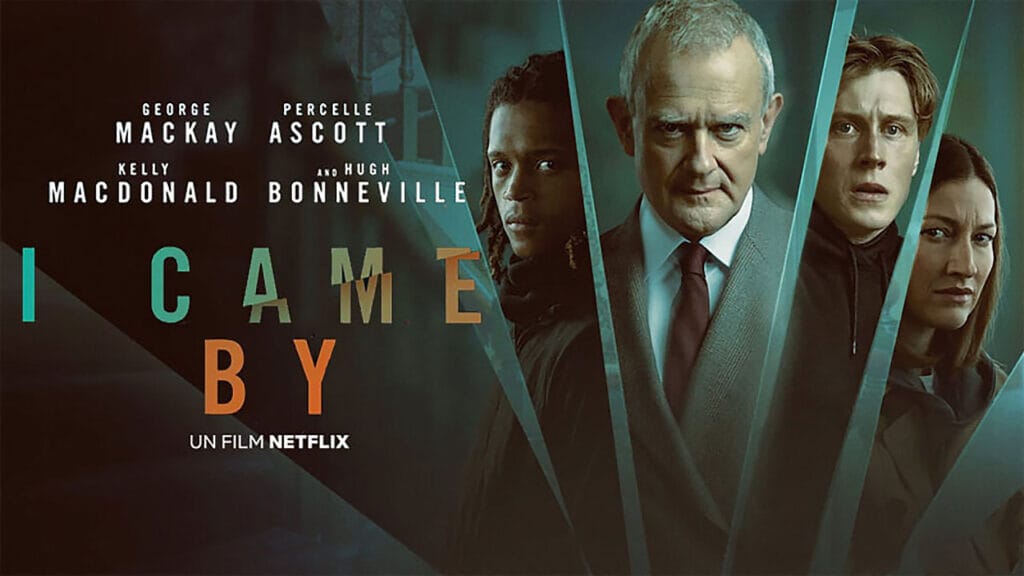
The thriller I Came By tells the story of childhood friends Toby and Jay, now in their early twenties, who break into the houses of very wealthy people in London and spray paint “I came by” on their walls.
Important reminder before reading: Like other reviews from an antinatalist perspective on movies and TV shows, this one is full of spoilers, so anyone who hasn’t watched the movie and plans to do so, please watch the movie first and then read this text.
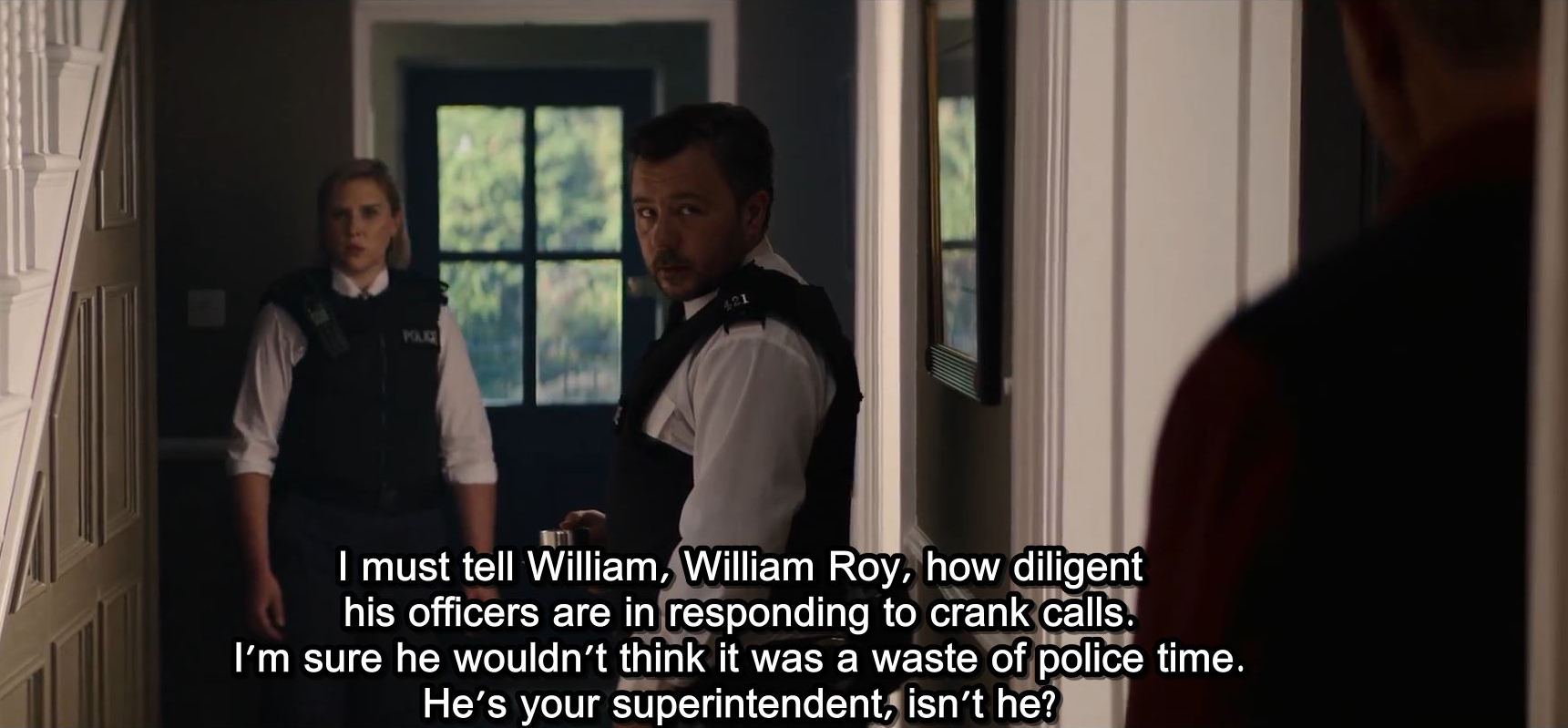
Back to the film, Toby wants to break into the house of a famous former judge named Hector Blake, but Jay refuses, partly because the judge is known for helping refugees and asylum seekers. Toby is not convinced by Blake’s saintly public image and goes alone. In Blake’s apartment, Toby notices a light under a hidden door in the basement and goes to check it out. Toby is horrified by what he sees inside the room through the peephole. Blake, who is outside the house that night, receives a notification on his phone that the alarm has been turned off and so he rushes back to his house. Toby manages to sneak out without Blake seeing him, makes an anonymous call to the police, and watches the house from a distance. While the police search the house, Blake implicitly threatens the officers so to get them off his back. He tells them: “I must tell William, William Roy, how diligent his officers are in responding to crank calls. [chuckles] I’m sure he wouldn’t think it was a waste of police time. He’s your superintendent, isn’t he? Good squash player. Keeps me on my toes, anyway.” It works out for him.
Toby sees that the police were quick to leave, and empty handed, so he decides to break in again. He opens the basement door and sees a very skinny, beaten, and injured man sitting on a mattress. Toby hears that Blake is back and lurking in the closet. He tries to attack him but slips and falls. Blake hits him with a bat and locks him in the basement too.
Since it has been 72 hours since anyone last heard from him, Toby is considered a missing person. An official investigation is opened by the police, and an independent one by Toby’s mother, Liz. A policewoman makes the connection between the anonymous phone call about someone being locked in Blake’s basement, a letter written by Blake that is found in Toby’s drawer by Liz (Jay took it from Blake’s mailbox and put it in the drawer so that his mother could find it and give it to the police), and Toby’s disappearance. The detective arrives at Blake’s house and asks him to open the door to the secret room in the basement, only to find that the room is empty and spotless. Blake was ready for this, so he murdered Toby and the other person who was locked in his basement, and burned their bodies along with anything that could incriminate him, in a crematorium he had built especially for this purpose. The detective finds it strange that the peephole is looking in instead of the other way around, and therefore still suspects Blake. He is very confident and tells her “Is that all you got? You looked like one of the smart ones”, she gets angry and arrests him.
But Blake manages to use his connections and gets away with it.
Liz is very frustrated by this and asks Jay to break into Blake’s house. He refuses and she goes alone. After a short struggle, Blake locks her up too. He shows her how he cuts off the head of one of his victims so he can get into the crematorium, and tells her that he poured her son’s ashes down the toilet.
After Jay tries to call Liz several times, leaves her several messages, and tried her house a few times without hearing from her, he enters her house and sees a lot of mail thrown on the floor, and rotten fruit in the kitchen. He realizes that she must have gone to Blake’s house alone and that she is probably being held captive in his basement. He decides to break in to free her but discovers that Blake has moved. Jay’s girlfriend, a law student, told him that Blake is going to attend the school’s 300th anniversary celebrations. Jay decides to follow him to his new house. He breaks in and they struggle. Jay manages to subdue Blake and tie him up. He frees whoever is in the basement, calls the police, and flees, not before spraying on the wall ‘I Came By’.
Give Up the Fight
You’re probably wondering why I find this film interesting from an antinatalist perspective, but I think there are some antinatalist angles worth mentioning. For example, that reproduction is the creation of a person in an unjust world , as the film points out unfair social and economic gaps, even with a brief mention of colonialism, and more importantly, it shows how powerful people, like Blake, can use their power and connections to get away with very serious crimes.
Another antinatalist angle worth mentioning is the several models of bad parenting, to varying degrees, that are demonstrated throughout the film. Blake becomes a serial killer as a result of childhood trauma caused by his father. Blake accuses his father of abusing his mother to the point of her killing herself, and Blake was the one who found her with her wrists slashed when he was still a child. This was after his father kicked his mother out of their home and sent Blake to boarding school so he could be with a young immigrant who he took under his wing and later became his lover and life partner. This is why Blake’s victims, at least the ones he deliberately chooses to be his victims, are young immigrant men of the same ethnicity as his father’s lover. This is his sick way of taking revenge.
Other models of bad parenting are of course much less extreme, yet still worth mentioning.
Without a doubt, the least relevant example of bad parenting, and quite different from any other example in the film, is Liz, as she is not at all neglectful and seems to have been a good mother to Toby as a teenager, and also to Jay, who was a member of their household, and even now that Toby is an adult, she still cares about him. However, her care seems to happen mainly after she realized that her son might be in danger, since before that, she mostly mocked and belittled Toby. She told him “What have you learned on YouTube today? Solved the world’s problems, have we?”, and urged him to do something with himself. At one point, she even takes his keys and throws him out of the house. Since Liz is aware that her son is trying to “solve the world’s problems,” she should be proud, and more importantly, very supportive, not mocking him. However, Liz’s case is much more complex and ambivalent, and again, probably the least relevant example of bad parenting in the film, but I find it worthy of mention nonetheless.
The parents of Jay’s girlfriend, Naz, kicked her out of the house because they object to her relationship with Jay and the fact that she is pregnant.
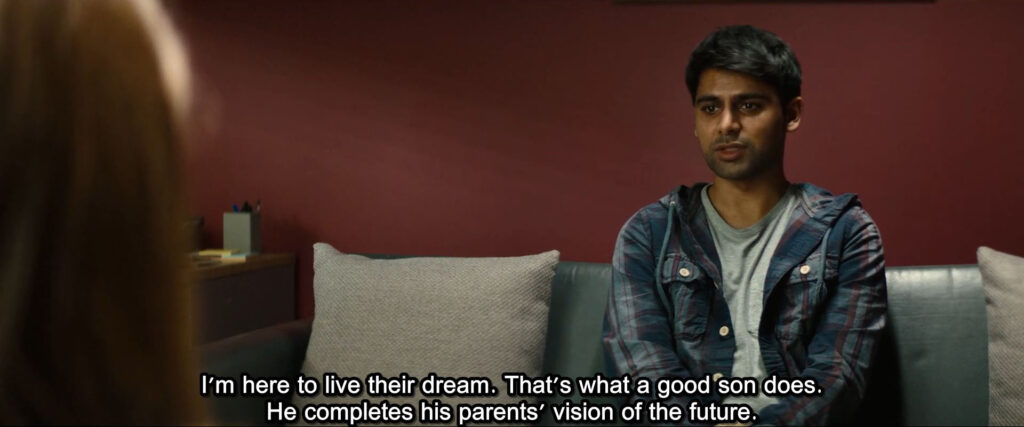
And probably the strongest example of bad parenting (apart from Blake of course) is one of Liz’s patients (she’s a psychotherapist), a young man named Faisal who experiences enormous pressure from his parents to become a doctor despite his interest in computers, and whose medical studies cause him severe anxiety (he can’t even look at blood without fainting). Yet he studies medicine because, in his own words: “I’m here to live their dream. That’s what a good son does. He completes his parents’ vision of the future.” And adds that: “They’d be so disappointed if I drop out. My mum wouldn’t ever get over it.”
Later in the movie we find out that Faisal couldn’t take it anymore and tried to kill himself.
Liz suggests that “Maybe you didn’t really want to die. Maybe your suicide attempt was a declaration of how much you actually want to live. Your way of telling your parents what you can’t seem to say in words.” But Faisal replies confidently “No. I wanted to die. I wanted my parents to understand that they’d failed me.”
While I find the last example very interesting and important, I want to focus on Jay’s decision to stop his and Toby’s activities for good. The two have the following conversation:
Jay: I can’t do this no more. Naz is pregnant.
Toby: Well, fuck.
Jay: [laughing] Yeah! I know.
Toby: She’s not gonna keep it, is she?
Jay: Of course she’s gonna fucking keep it. I mean, we’re both excited.
Look, I know. I know it’s a bit unexpected. But…
Toby: Unexpected? Who the fuck wants a kid at 23?
Jay: Um… Your mum?
Toby: She doesn’t count.
Jay: Yo, listen. This changes shit.
Look, I… I can’t do no more missions. Yeah?
You know the feds have me on their radar, and I can’t risk going back in pen.
Toby: No one is going back in the pen. You and me run this thing like clockwork.
You know I can’t do this on my own.
Jay: I know, but maybe we need to call it a day.
Toby: Writing was your thing, Jameel. Fight the system, remember?
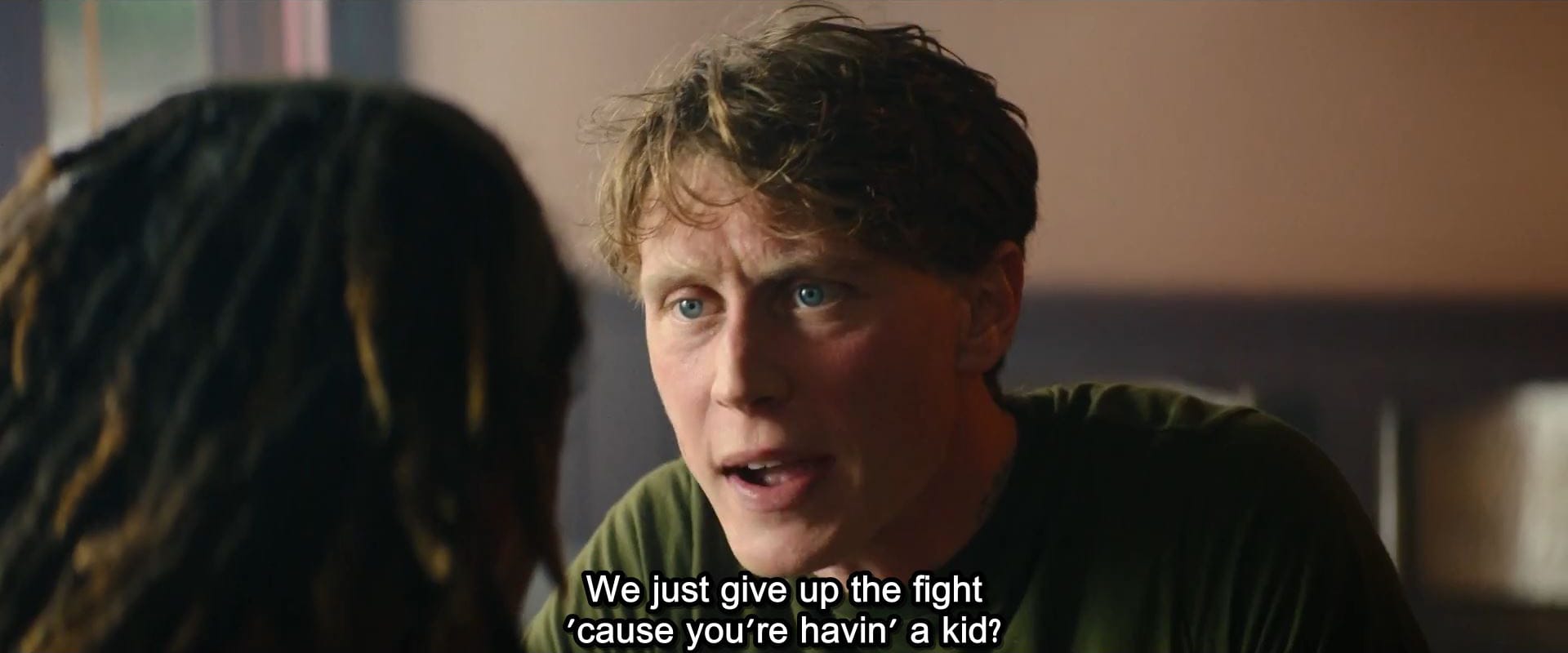
We just give up the fight ‘cause you’re havin’ a kid?
Jay: But what difference have we really made?
Toby: We’ve shown we can get to them. We can get right inside their homes any time we want.
Jay: Yes, and we’ve made our point, so let’s just move on.
Toby: Aah! You don’t even want this kid. You’re just doin’ this for her.
Jay: Fuck you for that, Toby.
Toby: Jay, you can’t wimp out on me. I need you, bro!
Jay: Nah, bro. My child needs me. Yeah?
Look, I ain’t havin’ him grow up the same way that we did.
Listen, if you wanna keep writin’, yeah, you do that. But you keep me out of it.
Everyone knows that everyone lives in a structurally unfair and unjust world. Most people are pretty indifferent to it and focus on their own little lives. Jay doesn’t. He’s trying to fight the system. The effectiveness of his fight may be questionable, but there’s no doubt that he’s well aware of how fundamentally unfair the world is. That’s why when someone like him decides to create a new human, and as a result, as Toby says, “just give up the fight ‘cause you’re havin’ a kid?” it’s much more depressing.
Most people are so indifferent that they don’t even bother to consider whether they should bother to consider the fact that life in this world is fundamentally unfair before they create new people. People force their children to live in a broken and unfair world almost without even thinking about it.
Parents force their children to live in an unfair world where no matter what they do, bad things can always happen to them. No one chooses to be created, certainly not to be created in such an unfair world. Existence in such a fundamentally unfair world is forced upon everyone without their consent. The fact that the only way to create a new person is in such an unjust world is no excuse for creating people in such an unjust world. And this is especially true because there is nothing unjust about not creating people. No one is treated unjustly, unfairly, or is harmed by not being created.
Parents must take into account this dreadful imposition when they consider whether to create new people. People who choose to procreate are active participants in perpetuating this unjust world by throwing more and more victims and victimizers into it.
The ethical thing to do, given that the world is fundamentally and systematically unjust, is to refrain from creating people. And that is certainly expected of someone like Jay who is well aware of how unjust this world is, and that the structural injustice begins before a person is born. Being black, an immigrant, raised in a broken home, and highly socially and politically aware, he is especially aware that many things are predetermined for every person created, obviously without that person doing anything to bring it about. Everyone knows that it is deeply unfair that every person begins life with everything about them (including factors that have a critical impact on the rest of their lives) having nothing to do with anything that person did; that no one chooses where to be born, to whom, their personality, their body, their physical condition, their genetic makeup, etc. And everyone knows that bad things often happen to good people and good things happen to bad people, but most people don’t even think about it, and Jay lives it every day. He lives it as one who is very aware of the fundamentally unjust system, as its victim and a fighter against it. And these are very good reasons not to create a person in the world.
Given how fundamentally unfair life is, creating a human is always a fundamentally unjust decision. But when one is, or can be, a force for change in this unjust world, it is an even more unjust decision. And anyone can, and should, be a force for change in this unjust world.
According to estimates, the average cost of raising a child from birth to adulthood is over $230,000. This amount does not include the cost of academic education, nor when the child remains living with the parents after the age of 17, which happens in the vast majority of cases.
And the enormous financial cost is not the only thing to consider. If parents spend an average of about 3 hours a day with their children, by the time they are 18, that amounts to about 20,000 hours.
And there are other important considerations that are hard to measure. It is hard to measure how much energy is involved in raising children, but it is certainly a huge amount.
The point is, if people had invested all that time, money, and energy in needs that already existed instead of those they decided to create out of thin air, this world would surely be less unjust and unfair than it is now.
This is why the decision to invest so much time, so much energy, and resources in just one person, especially one who needed no attention before being created, when there are so many other living beings who already exist and need help with great urgency, is so morally wrong.
Jay tells Toby that his child needs him, but before being created, his child didn’t need him, or anything else for that matter. It is Jay’s decision to create a child that creates the child’s need for him. No one needs anything before they are created.
On the other hand, existing people do need things, for example, they need people to fight against injustice and inequality. Again, the effectiveness of their specific activism may be questionable, but it is clear that two young, intelligent, bold, and resourceful activists like Jay and Toby could be an asset to any important cause. Instead, one of them decides to create new needs that weren’t there prior to his decision, and dedicates himself to trying to fulfill those needs that he himself created.
Every activist knows how desperate activists are for help, and how important every activist is, so a decision to divert someone’s time, energy, and resources so dramatically to someone who needs them just because they created that someone, even though that someone didn’t need anything before they decided to create them, is adding problems to a world that is already full of problems. It is a decision to create yet another person who will harm others simply by their very existence, and who will divert the time and resources of their activist parents from problems that existed before and regardless of their creation.
Reproduction is, among other things, a diversion of energy, time, and resources from those who already exist and are in need, to those who needed nothing before they were forced into existence, who would be deprived of nothing, and who would be harmed by nothing if they were never created. Why create another center of need and frustration when there are already billions of them out there, some desperate for any help possible?